Category Archives: Hitchhiking

On The Road #11, Hippies

Two overgrown tracks of a forgotten road lead my way north, over a ridge in the foothills of the Pocono Mountains, and into the next watershed. My pant legs and shoes were wet with dew from the grass growing in the tracks and the brush crowding out the road. The forest floor was spongy with April thaw. But the air—Ah! The air!—was clear as coastal rain and filled with the scent of awakening forest, a clean mustiness from wood and leaves beginning to decay in the warming air.

It must have taken me several hours to walk those abandoned ruts through the woods but all I remember is the coolness and quiet, the light through the woods, and the delicious air.

Just as Ann had promised, I came upon a paved road. I turned right. Before long a substantial bridge was in sight. Several hundred yards before I reached the bridge a guy on a bicycle came up behind me.

Ann had said there were some hippies l might want to run into over here and, it seemed, one had run into me. A lanky quiet guy with the long hair and patchy clothes of the tribe, he stopped his bike and we chatted a bit. He said, yea, his bunch of hippies were staying at a place just back up the road and he was headed to town for some food. He figured it would be OK for me to crash the night, but everyone else was out of town and wouldn’t be back until late. So I sat on the handlebars of his bike and  he peddled us across the Delaware River to Narrowsburg, New York.narrowburg
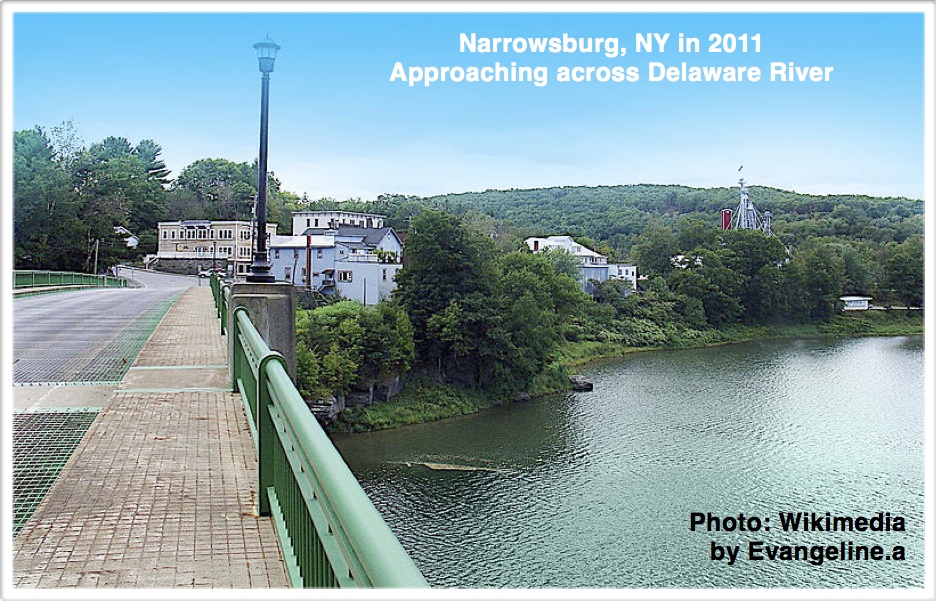
On the way a car passed and stopped so the lady in the passenger seat could bark at us about riding on the wrong side of the road. I barked back that it was safer facing traffic and she rebarked about the law. That was the end of it. When we were on our way again the guy peddling the bike moved to the other side of the road and quietly said he found it best to not bark when barked at. Just listen and go along. He was right, of course. Those darned hippies and their logically peaceful ways.

That evening we chatted and I painted some little esoteric image on their wall. I was looking forward to meeting everyone but got tired and rolled my sleeping bag out on the floor of one of the bedrooms. It was hard but dry.

I was nudged awake with the sound of anxious voices coming through the door and soon knew the anxiety was over me. “But I don’t think he’s like that,” the guy from the bike was saying. He was being challenged with how careful they have to be. How many people are out to get them. How easy it is to screw up.

I heard the door to my room open and someone walk in. Not being one for confrontation I maintained my most angelic appearance of slumbering innocence. The door closed.

By the next morning there were only myself and the guy from the bike in the house.

And that was my night with the Merry Pranksters.

On The Road #10, Ann & Jerry part 4

I enjoyed two delicious days at Ann and Jerry’s little cabin resort in the Pocono Mountains. Two days chatting and playing chess and doing odd jobs in the damp chill of April, 1969. Two days of enjoying Ann’s delicious (and HOT!) cooking! Two nights in a dry, soft, warm bed.

It was a heavenly break from walking the back roads of eastern Pennsylvania, but the chores of spring cleaning were done. It was time to move on.

Along with chats about pot and gays and alternate life styles, Ann and Jerry had shown an interest in my plans, such as they were. On a map I had noticed a little black line of a road through the Catskill Mountains and was generally drifting that way if nothing came up to divert me. They told me they had heard a bunch of hippies were staying just outside of Narrowsburg, New York. Narrowsburg was on the Delaware river, just across the boarder from Pennsylvania, and on my way. Ann suggested that if I wanted to run into them she knew a short cut going over the hills instead of following the river.

So, on the second day after I first ran into Ann getting her mail beside the river, they led me from their delicious breakfast table, away from the river, back past the cabin I had been sleeping in, and pointed out a set of overgrown tracks leading into the Pocono Mountains. Filled with brush and high grasses, the tracks were mostly visible by the clearing they made in the trees. My feet stepped into the wet foliage and I began a day’s walk over the ridge to the next drainage north, where I had been assured I’d run into a road leading to Narrowsburg.

There are few things more spongy and aromatic and quiet than the dewy broadleaf forests of the eastern United States in the early spring, just as the snow has melted and the grasses have greened and the woody plants are only beginning to unfurl their leaves.

On The Road #9, Ann & Jerry part 3

A NOTE: This is the third story from an April stop along a river in eastern Pennsylvania. For the story just before this one, which explains Jerry’s behavior, see On The Road #8, Ann & Jerry part 2

I have been purposefully vague about Ann and Jerry’s identity and the location of their summer cabins in the Pocono Mountains. With this story you’ll understand why I am protecting these delightful folks, whom I cherish. If you should recognize them I’d love for you to get hold of me and tell me your experiences with them.

________________________

Jerry and I spent a second day fixing up their cabins, tightening screws and checking wires and clearing brush. But mostly I remember Jerry always eager to get out the chess set. After breakfast and after lunch. The minute a break was declared. To this day I doubt he cared that much about getting the cabins in order for their guests — he had a chess partner!

At one point we had put up the kings and rooks and pawns and I found myself in the garage. I don’t remember if I was looking for a tool or getting paint, but I do remember concentrating on something when in walked Jerry. As matter-of-factly as if we were discussing what color to paint the screen door he told me he’d always thought of having sex with a guy and he’d like to get it on with me.

That, my friends, caught me off guard. I was in my early twenties and had never been propositioned by a man in his seventies before. Much less a man who’s wife had been cooking me meals and with whom we’d all been sharing stories and the comforts of their home.

But mostly I reacted to his age. I couldn’t imagine sex with him, no matter how much I had come to like him. To be kind (I told myself it was to be kind. Actually it was from years of making it a default reaction to lie about my sexual intent. But that’s another story) I told him I wouldn’t feel comfortable doing that because he was married.

“It’s because I’m too old, isn’t it?” Jerry asked.

I lied, no, it’s because he was married and I liked Ann and wouldn’t feel right about it. Some of which was true. But mostly it was a lie. I was reacting to his age.

And that, dear reader, is one of the regrets I carry from my hitch hiking days. Not being honest to Jerry. Why wouldn’t I have been? He was certainly honest and open with me.

And, of course, I’m curious what it would have been like to smile and have fun instead of defaulting to my usual excuse-finding escaping when the dicy and much desired reality of lust comes dancing about.

On The Road #8, Ann & Jerry part 2

Warmed by Ann’s delightful hot breakfast and basking in Ann and Jerry’s enthusiastic hospitality I gladly took to raking the winter’s deposits of leaves and branches that littered the grounds between their three or four small cabins. Everything was heavy with April’s rains but the fresh smell of the work made it a treat. The warmth of Ann’s pancakes was joined by the heat of physical activity. Jerry joined me, filled with instructions and what help he could manage. It was a delight.

That evening Jerry asked if I played chess and soon the board was between us. Jerry did love to play chess and both Jerry and Ann loved to chat. After a week on the road their home was so warm and their company so welcome, I reveled in it. And I got better at chess!

It turned out Jerry had spent some time in Idaho back in his youth, cowboying around Pocatello. He and Ann were from the era of the Great Depression and I was a young buck hitch hiking around the country in 1969, no doubt a hippie with a haircut.

“Well, yea,” Jerry said. “We knew all about marijuana when I was working in Idaho. It was a weed along the streams. All we knew was to keep the cows out of it or they’d fall down. Didn’t occur to us to try smoking it—and it’s probably a good thing we didn’t!” Ann joined us in a good laugh.

The Viet Nam war came up, of course. And the question of how I could be out living on the road, being of draft age and all. I told them I’d been deemed too immoral to fight in that war and told the story of checking the “homosexual tendencies” box during my pre-induction physical. Like pot, being homosexual was just another perfectly natural subject to these seasoned citizens of the Pennsylvania mountains.

That night I enjoyed the comforts of one of Ann and Jerry’s cabins. The bed, so warm and soft after a week sleeping beside the road, was heaven.

Having a desk and stationary from Ann and Jerry’s mountain retreat , I wrote a letter home. Next time I’ll share it with you.

On The Road #7, Ann & Jerry part 1

The stars that had been high in the black sky had set in the west and finally the eastern horizon began to glow.

I nodded off again, there beside the rippling river swollen with spring runoff. My heavy wool coat, crisp with frost, was spread over my ancient cotton sleeping bag.

My eyes opened to the first ray of sunlight glistening in the hoarfrost that covered every blade of winter-weary stubble. The ray was squeaking its way through concentrations of fog lazing over the river. So comforting, that ray of light. So promising of warmth. So beautiful on the frost.

I fell back to sleep.

The sun was not very high in the sky when I stirred. Sleeping beside the road exposes one to whoever travels by, so it was time to get up.

It didn’t take long to gulp down a couple spoons full of cold beans, kept from freezing in my sleeping bag.

Shaking the frost off my coat and getting into it—getting my box of paints out of the bag, where they had shared my warmth with the can of beans—rolling up the sleeping bag and cinching the rope around it. None of it took long. Lackawaxen

The sun was shining, although softened with the lumpy fog. I stepped over the guardrail and headed east, glad for the movement. Movement that meant warming up.

The river had rushed and sparkled on my right for some half mile when I noticed a lady walking across the road in front of me. She stopped on my side of the road and opened a mailbox. Once she closed her mailbox she looked at this stranger walking the road, hesitated, and then stayed put.

When I was in earshot I gave a “Good morning” shout-out. “What a beautiful day!”

She asked what I was up to and we enjoyed a brief chat before she pointed out the little white house on the other side of the road and the few small buildings behind it.

“We rent these cabins during the summer. We love this place but must admit its gotten to be a bit much to keep up with now that we’re in our seventies. We could sure use some help raking up and getting ready for the guests. Would you like to stay in one of the cabins for a few nights?”

Ten minutes later I was enjoying hot pancakes that drooled warm butter and syrup. Sizzling bacon. Steaming coffee. And warm conversation.

Now, forty-four years later, my eyes well up remembering how good it was—the heat and the flavors and the enthusiasm.

And how I still cherish Ann and Jerry.

On The Road #6, great clock

My travels through the forests of eastern Pennsylvania found me walking a quiet roadway beside a good sized river. Not the Hudson or Mississippi by any means, more like the rivers I had been raised around in Idaho—rippling along, certainly too wide, deep and swift to wade across but fine for high rubber boots and a fishing line.

The sky had cleared and I had enjoyed a rather warm, dry day on the road. As night fell I began looking and found a little flat point of land jutting toward the river. I stepped across the guardrail and rolled out my bag.

My sleeping bag was WWII surplus, a khaki canvas liner and shell stuffed with dense cotton batting. It was roomy, heavy, and rather miserable when damp, which had been a chronic condition that early spring of 1969.

Thanks to the sunny day my bag was finally dry. I snuggled in when it got dark, since there was nothing else to do, and—well—began to freeze. The clear skies dropped the temperature as soon as the sun disappeared. It just got colder.

The river rippled, the sound of water soothing but seeming to make it colder. It was dark as the dickens. And the stars were splendid. Stunning.

Finally I nodded off.

It was probably two hours later when the cold woke me. Gosh it was cold. But the stars had changed. The patterns I had seen directly overhead were now shifted to the right, having moved from the twelve o’clock position to the two o’clock position. The patterns that had been on my right were gone and the patterns I had noticed on my left were now higher in the sky, at ten o’clock.

I realized when those stars now at ten o’clock were at four o’clock it would mean the cold would soon end. When they hit the far horizon the light would be breaking.

I had enjoyed the stars before, of course. But that night they became the grandest clock of all, ticked off the cold. Promising the warm.

Astronomy changed for me that night. And I for it.

On The Road #5, postmaster

I found myself in eastern Pennsylvania that spring of 1969, cresting a rolling hill, and facing a straight stretch of road cut through the encroaching forest. There was a light mist of rain. The cresting road rolled into a gentle downward slope, bottoming out some quarter-mile distant before beginning an easy climb. At the bottom of the slope it looked like there was a wide spot cut into the woods.

I had written a letter home every week since running off to Hollywood five years earlier. It never crossed my mind that living on my feet, walking backroads, and having all of six cents in my pocket might add up to an excuse to break the letter habit. In fact, I had a letter to send and had spent the day looking for a post office. It was getting late, just losing light. I had to find a spot to roll out my sleeping bag.

As I reached the bottom of the hill the wide spot in the woods expanded to include a building. That one building was marked, U S Post Office, Greentown, Pennsylvania.

It was at least five o’clock. Even so there was a lone person in the building, behind the counter and putting on his coat. Expecting a locked door, I was surprised when it gave way.

Yes, he was closing up.

But, sure, he’d weigh my letter and make sure the single stamp was adequate.

It turns out the letter was overweight. The rural postmaster looked me over, pulled out his keys, and unlocked his drawer to sell me a second ounce stamp. Fortunately my six cents were adequate, even leaving change.

I thanked him profusely, affixed the stamp, delivered the letter to the slot across the lobby, and began to leave. One final turn to say thanks. We acknowledged one another and hesitated.

“Did you just mail a letter to your folks?”

“Yea.”

“Are you just passing through?”

“Yes.”

“Would you like a place to spend the night?”

I beamed.

His home could not have been more cozy. His beautiful wife stretched dinner to include an extra place at the table. The conversation was lively, with questions about Boise and Idaho, which he had notice on my letter. We spoke of hitch hiking and adventuring and the lovely forests of the eastern United States, something his two daughters had not considered.

After dinner I insisted on washing the dishes to say thanks, despite the postmaster’s insistence that his daughter’s chores covered that. While mom and dad rested in the living room their junior high-aged daughters could not get enough, more than happy to help this tall stranger from the mystery of the road who had taken over their nightly chore.

After dishes I joined the conversation in the living room where we became more intimate. The daughters, it turned out, had an older brother—a brother who was fighting in Vietnam. The fight that was tearing the United States apart. The fight I was not participated in.

“We worry about him, of course,” the postmaster said. “We hope if he needs help someone takes care of him. So I couldn’t leave you outside tonight.”

That night I lay, warm and dry in their son’s bed. A photograph of him in his dress uniform was on the corner nook, watching over me.

For one night this empty room in a loving family’s home had the sound of breath. I hope their son slept as soundly as I did.

On The Road #4, sunlight

I don’t remember. This day might have been in northern New Jersey, but I’m pretty sure it was eastern Pennsylvania.

I do remember I had 6¢ in my pocket, which had been a carefully considered decision. In those days, to pick up a pay phone and talk with an operator to make a long distance call you had to insert a dime. After you’ve found someone to ask what a “pay phone” or a “long distance call” is, I’ll continue my story —

After buying a much-needed toothbrush and feeding myself for several days, I found myself with a few coins in my pocket. To even buy a can of kidney beans I had to break my last dime. I had the choice between something to eat and a last chance to call home asking for help to get off the road.

I left the little country store with 6¢ and a can of beans.

Those six cents were on my mind that afternoon, as I passed through lush woods and farms, but there was not much time for obsessing. The air was so fresh. The winding country road was so inviting. And the springtime mist was often sprinkled with moments of glorious sunshine. The gray of the sky would part into brilliant blue and billowing white. The wet greens of springtime earth would sing in vibrant, crystalline light.

About two in the afternoon a bit of straight road was wet and sparkling in the sunshine. An old wood fence on my right offered a place to sit and ease the cotton sleeping bag off my shoulder. Across the road another wood fence separated the grass next to the road from the grass in a pasture—all glowing in the light and just hinting of the color of budding flowers. Rolling hills gave a weaving distant edge to the pasture, covered in gray trunks of trees, topped with yellow and ruby red branches just filling with life.

A few seconds? Ten minutes? Thirty?

Even now the sunshine and the air and the color and the being of it breath through me. So beautiful.

And, like now, the time came for a different slant.

I was past hungry, having tried to save the beans for when they were really needed. Leaning against the fence I opened the can and found my spoon and savored nourishment that was as preserved as the air and the light were spontaneous. (Although I didn’t think of that until now. At the time I only thought how luscious those beans were.)

Half way through the beans I decided to save the rest for dinner. There was no putting the lid back on those sticky beans so I stuffed the open can in the top of the roll of my sleeping bag where it would be held upright.

I licked the spoon clean, put it in my pocket, and kissed that lovely moment and that beautiful, sun-lit space, Thanks.

On The Road #3, water

I hit the road walking north from Princeton, New Jersey, in the early spring of 1969. I didn’t think much about carrying a heavy, WWII surplus, cotton-stuffed sleeping bag my aunt and uncle Celesta and Paul Huff had given me. A long coat of heavy wool was just a coat. And I didn’t hesitate to tote along a seven-pound wooden box of artist’s paints. 

But I was concerned about weight so decided not to burden myself with a toothbrush. 

Opps.

It turns out fingers make bad toothbrushes, no matter how vigorously one squeaks them across one’s enamel. Although I was avoiding major highways and cities, I did regularly pass through small communities. The first one I passed through on my second day on the road is where I spent a bit of my limited financial situation on a delightful device to brush my teeth. No toothpaste—too expensive and too heavy. But the brush? You bet.

One thing I did not lack for cleaning my teeth was water. 

It was springtime in the hills of northern New Jersey and eastern Pennsylvania. Snow was melting so any brook was a stream and the streams were small rivers. But these waterways were difficult to get to, often running with steep banks covered with wet grass—a trap just waiting for a hapless hippie, heavy with packs, to slide into. The easily accessible, gentle slopes and sandy beaches on these high-water streams were all tucked well behind the Private Property — No Trespassing signs that were posted on every other tree.  

Compared to the snarling dogs of the snow-fed streams, I found water that was as pleasant as a  flicking finch. It gently rushed in small rivulets, usually through grass but sometimes gravel. It was clean as polished crystal in sunshine, cool and fresh, and available within a few feet from everywhere my feet fell. 

This water had just fallen in the misty rain that filled the days and nights. It was often an inch deep, a few inches wide, and always running swiftly. It was the water beside the road, running between the roadbed and the cuts that had been graded through the hills. 

I had always lived in deserts. My mountain hiking had been where rushing streams were few and far between, and then possibly polluted. These roadside rivulets of rain-fresh water were new to me. 

I may have been damp and cold, sleeping in this springtime weather without a tent. But to this day I remember how lucky I was to enjoy those fresh, abundant, and pleasant sources of beautiful water.

On The Road #2, New Jersey lessons

The New Jersey countryside was wooded hills and just-greening farms when I lit out from Princeton in the spring of 1969.

After a day of walking north on an obscure road the light began to fade and I started to look for a spot to sleep. The fields were too muddy and I wouldn’t have wanted to irk the farmers anyway. The forests were posted as private property with emphatic No Trespassing instructions.

It was all a quandary and getting darker when I saw smoke from a campfire across an abandoned field. There were a couple of young guys at the fire and they seemed to be waving me over. After some Who? Me? gestures I walked across the field, perhaps some two blocks distant from the road, and took my shoes off to cross a stream running swift and very cold from the spring thaw.

The guys turned out to be high school buddies enjoying a favorite camping spot. The stream I crossed was joined by another just west of their camp, making a tip of land caressed by the sound of rushing water. Complimenting the noisy atmosphere were all the amenities a young men’s camp needs— A few rocks to sit on. A campfire. A small tent. A few pots and pans. And a brand new electric lantern, the most modern kind available, with a short length of florescent bulb meant to light the entire camp. A vast improvement over flashlights.

I rolled out my sleeping bag beside their tent, confident it wouldn’t rain. The darkness gathered. Soon we were in a cocoon of flickering campfire conversation.

Then I hear a thud. Before I had time to think a thud in the night was rather odd my camping companions were on their feet, the florescent light was out, and a rusty stick of metal had materialized from their tent. I soon realized the rusty stick was an ancient BB gun, long since having lost its wooden stock but still perfectly capable of being pumped and shot.

As BB pellets volleyed into the darkness rocks began to rain into our campsite from several directions across the two streams.

“They better not break my new lantern,” was the only concern I heard as the two New Jersey campers grabbed the device and told me to follow them, still shooting blind into the woods. We retreated some hundred feet before they turned and said we’d be OK, “The rocks cant’ get this far.” Apparently the BBs could since pellets kept being pumped into the darkness.

The next morning we broke camp and the shooter insisted he carry me across the cold stream. It was awkward, me being a half a foot taller, hanging onto his back. The two guys walked off through the field headed southwest and I was just heading north when I saw the rusted stick of a BB gun where it had been dropped in the grass. I picked it up and called out. They were glad to have it found and I was glad for an adventurous camp.

And that’s how I learned two things. First, a highlight of New Jersey high school camping was waiting for your buddies to sneak up and throw rocks at you. Second, it certainly was wise to find a camping spot where swift, cold motes are too dangerous to cross in the dark.