Author Archives: deansgreatwahoo

Unknown's avatar

About deansgreatwahoo

After graduating in 1964 I headed to Hollywood to be a movie star, only to drop into the '60s. Lucky me! After hitch hiking around the country from '69 to '72, I graduated from Boise State University and settled into waiting tables for a living and pursuing other interests—teaching stained glass at BSU, writing for Boise Weekly and Idaho Magazine, publishing some Idaho and Biblical history, acting in a few local shows, and traveling at the drop of a map. For two years I produced a half-hour public access TV show available at www.greatwahoo.com. In 2011 I was featured in Scott Pasfield's book Gay In America. Through it all I've come up with some stories and am using this blog as an excuse to get them written down.

Frost Valley #9: A Yellow House

There were two summer homes on the private estate where I spent the summer of 1969, one a few miles upstream from the compound that included the lodge and the other a few miles downstream. INT

Come mid-summer Stan said one of the chores for 1969 was getting the upstream house painted. They had hired a professional painter and since most maintenance chores on the estate had slowed down I could keep busy helping him out.

At the time acrylic paints, those wonders that let clean-up be done with water, were fine for indoor work but no respectable professional painter would ever use them for exterior coverage. They just did not stand up to the cold and water and sun like good oil-based paint did.

So, up Frost Valley I went and cursed to cleaning up with solvents I was.

The painter taught me more our first day together than I have learned about house painting before or since.

First, scrapping is the most important part of the job. (I figured out on my own that scrapping sure makes one glad to be finished with pushing steel over wood and to start painting!)

Second, the house was sided in long slats of wood, about three inches wide, running horizontally across the walls. The painter started off by explaining that if we were using acrylic paint we could paint whatever we could reach from the ladder, square blocks immediately in front of us, and when we overlapped them with the next square block we painted they would blend right in.

But oil-based paint isn’t like that. If it gets tacky or dry and you paint over it it, even though it is exactly the same paint, where they overlap there will always be a different color. So we painted three boards at a time, reaching as far along the length of those three boards as we could, and then we moved the ladder and continued painting those three boards all across the wall. There was plenty of moving ladders that summer.

Third, he taught me to keep the paint on the tips of the brush. Take small dips of paint to the wall and don’t let it get past half way up the bristles of the brush. Painting is so much more pleasant when your hands are not slippery with paint.

And forth, he taught me not to sweat cleaning up. It’s no big deal, especially when the paint is all in the end of the bristles of the brush. Just swish it about a bit in the solvent and flip the solvent and paint off the brush with a good swing of the arm. Two or three swishings and flippings does the trick.

I’ve since learned that with acrylic paint, where you are dealing with water to clean up, just a touch of soap on the bristles when you have finished cleaning them keeps them nice and soft. (I’ve also figured out that disposable brushes are much better than they used to be, but that’s our little secret.)

We got along well, that painter and I, but I do remember one awkward moment—

It was 1969 and I was a young wonderer, not serving in the military. One day I was on the roof, painting the areas under the eaves of a dormer window, when Stan and another local both managed to be spending some time chatting with the painter. They were right below where I was working. The conversation, as often happened that summer, got to hippies. Perhaps out of deference to my being in ear shot, the general tone of the discussion was that for the most part those hippies are OK.

“I will say one thing for those hippies,” the painter observed. “For the most part they seem to like girls.”

I instinctively turned to check that comment out and the painter was looking directly at me.

What does a shy young gay guy do?

I snapped back to my painting and to the rush of anxiety I had been caught up in since my youth when caught off guard about sex. Perhaps today I’d have pursued it with him. Perhaps it is just as well the topic was dropped by everyone.

We painted that house a beautiful light yellow with, as I remember, white trim. It looked real sharp. I was proud to have been part of the job and I was glad to have learned how to scrape and paint.

I’m also glad my home is sided with steel and has never needed my skills.
Frost Valley #8: True Trees & Heavy Steel

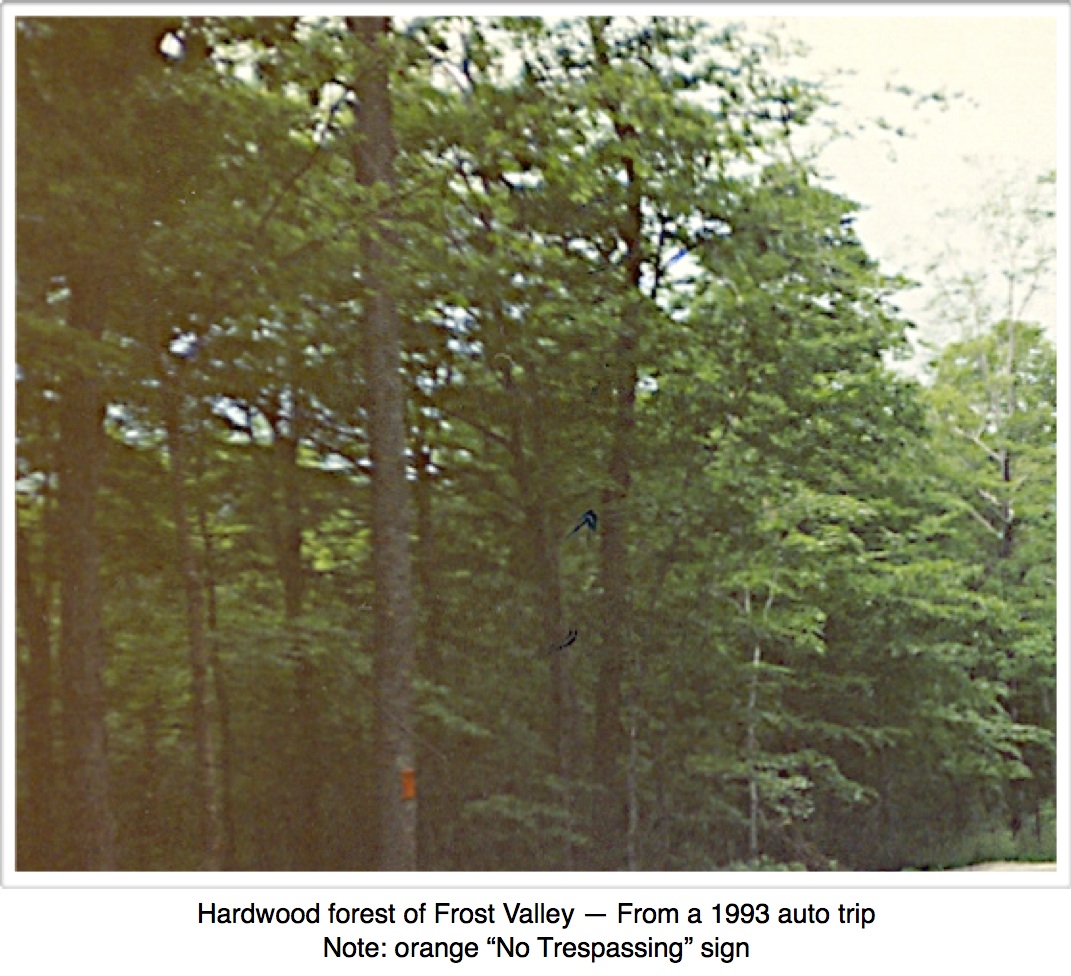
Frost Valley was named for a reason and a requirement for the private estate where I found myself being a handy man was two well-stocked woodpiles, one for the main house and one for the caretaker’s place. The caretaker, Stan, had been on the estate long enough to keep an eye out for promising firewood trees.

Once the early rush to keep grass mown and weeds out of the garden began to settle down, the earth in the forests had firmed up enough to get the 4X4 GMC Scout into the woods with a trailer. So we found ourselves tossing a chain saw and pry bars onto the trailer and setting out into the woods on barely noticeable ruts being overlapped with the branches of hardwood forest.

trees & steel photo

I figured we’d be searching for dying trees or gnarly old snags that would beautify the forest if removed, but Stan quickly set me straight. Perhaps such harvesting would beautify the forest, he agreed, but his job was to cut and split wood. And splitting gnarly snags and dying, unpredictable wood was a pain in the keester. Nope. He had his eye on the healthiest, straightest, most handsome trees in the forest—two or three he’d been eyeing for several years.

And handsome they were. Perhaps Elms? No matter. They stood straight and strong, with no branches for a long way up the trunk. I ended up appreciating that last detail.

It seemed a shame to me, chopping down such beautiful trees, but down they came.

In a surprisingly short time the first load was cut into foot-long sections, just right for the estate’s stoves, and loaded on the trailer. We hauled them to the shed area of the estate’s main compound, dumped them on the ground, and went back for more.

It would have taken less time if the final load had come out as easily as the rest of them. As Stan parked the Scout in the best place to pick up the last load he expressed concern for what looked like a soft spot in front of the Scout. But after testing the spot with his toe he figured it would be “OK.” Once the wood was loaded and the tools were in the back of the Scout it took only twenty feet for the weight of the load to turn “OK” to “creamy mud.”

Getting out to lock the front hubs of the Scout left us squishing in our socks. The granny gear and the four wheel drive just meant four wheels were digging in rather than two.

We cut our losses and walked back to the compound to get the tractor.

Next came the splitting—whether the logs we had just harvested or the dried harvest from the year before I don’t remember.

I do remember being taught how to split wood. First, to take the time to simply look at the cut end of each piece. Find the places it wants to be split. They are easy to find once you look for them—little cracks, usually around the edge, where the wood is already splitting. Then get the heavy maul high overhead and put most your effort into getting the sharp edge as close as you can to the little crack you’ve chosen. Yea, there is some effort put into the power to drive the maul through, but mostly gravity and the heavy steel will provide the oomph. Getting it where it will do the most good is what pops that wood open and sends two pieces clattering across the ground.

There is, of course, one other secret to splitting wood, and it is the secret that will keep you from having to twist and pull your maul out of a piece of wood that didn’t split. While reading the wood check the sides of the log for knots, the places where branches once were. You can split wood with the knot coming out the left or right side of your split, but no matter where the little cracks are running, if you try to drive your maul through a knot you will be putting more work into extracting the steel than it takes to split a dozen logs that pop right apart.

Trust me, I soon came to appreciate Stan’s insistence on trees that were straight and true and who’s branches (meaning strong knots) began way up the tree.

I was not a very strong guy, but I am six foot four, so by the time that maul smacked into those hardwood logs there was plenty of travel in that steel. I got to where I could split wood with the best of them and was surprised at how quickly those trees were turned into cords of split wood.

I can’t say as I’d want to make a living at it, but to this day I enjoy splitting wood. There is something very satisfying when the halves go flying several feet in two directions, as if the wood is glad to be liberated from itself.

Frost Valley #7: Hippies & Women

During my stay in Frost Valley, there were a few times Stan and I would run into folks who ignored the No Trespassing signs and pulled off the road to park beside Clear Creek for a picnic or camp-out.

One night we were driving back from a meeting of the volunteer fire department in Claryville when Stan impressed me by noticing some bent grass beside the road. Sure enough, following the tracks just past the willows we came upon a car. We kindly let the occupants gather themselves before politely letting them know they’d have to move along.

Another night Stan brought the Scout to a screeching halt in front of the barn I was staying in. The urgency in his voice startled me and I jumped up when hearing he needed my help. The Scout kicked gravel as we sped to the caretaker’s house, where Stan ran in and got his sidearm, something I had no idea he had. Then we were off, speeding down the valley while he explained he’d come across a bunch of hippies camping on the property and there were lots of them and he needed my backup while controlling the situation.

We have to remember, this was 1969. The battle of Vietnam was being fought on the home front as well as in Asia. Lines were drawn between long haired hippies and decent society. Both had their fears of one another.

Well. Stan knew I was something of a hippy. Even though I had cut my hair short to avoid confrontation on the back roads of America, I was, after all, hitching about the country and not in the war.

I don’t remember much about that fast ride a few miles down the twisty road, but I do remember keeping a calm voice and trying to mellow the situation out—all the while hoping we did not run into a camp of armed jackasses demanding some claim to camping that the State of New York did not grant them.

We got to the little service road leading to the hippy’s hidden spot and turned in. The camp had been picked up and their vehicles were in the last stages of being packed. Perhaps thanks to my being there Stan was able to see there was no threat coming from these young people in clothes that harkened back to our great-grandparents.

Stan ended up apologizing for having to kick them off the land and then explained there were public camping spots up the valley, owned by New York State. By this time it was dark and Stan continued, “You might have trouble finding the turn off. Follow me. I’ll take you there.”

My heart sings to this day, thinking of Stan jumping the divide that separated our nation.

Shortly after the hippy incident, we were in the Scout checking out the property when Stan observed, “You know, Dean. I’ve noticed. Every time I have to kick out hippies they always clean everything up real good. I never have had to pick up one scrap of anything. But these damned middle-aged women. They seem to think they can leave crap all over the place and everyone else should clean up after them.“

I quit worrying about hippies getting hurt in Frost Valley.

Frost Valley #6: A Local Concert

One daily highlight of maintaining the estate in Frost Valley was grabbing a bag of fish food and walking upstream some half-mile to feed the fish in the ponds behind the little meadow where I had met a baby skunk and had first been introduced to fireflies.

One afternoon in mid-August I saw a car parked on the road beside the meadow and discovered two guys sitting on the edge of the road, enjoying the view while they ate a simple picnic. The guys were both studs so I wasted no time introducing myself and sitting beside them to compare notes. I told my story of finding obscure roads to hitchhike on and they said they had found Frost Valley because they lived in Boston and were headed to a concert and figured this tiny line on a map would be a nice, wooded drive. Then we made out for a while there beside the road, all three of us thankful for the absence of traffic and confident we could hear any vehicle approaching in the small valley.

Once the meadow had been splendored beside, the two guys suggested I join them at the concert. I was sure Stan could spare the help since the estate’s chores were all caught up. But I did have the fish to feed and it was kind of cold and drizzly, I didn’t have a ticket and it would be a couple days before I was back and I had no food or bedroll packed. The guys assured me it would be OK but I declined and they went on down the road while I headed to the ponds to feed fish.

Two days later Stan needed something from a shop that was in Monticello, some thirteen miles south of the town of Liberty, where I had spent a night under a freeway bridge on my way to the middle of the Catskills. We took highway 42, a back-road short cut from Frost Valley to Monticello, and picked up what Stan needed. On the way back Stan wanted to take the long way, up Highway 17, the freeway-style road I had slept under in Liberty. He wanted to check out the big commotion that was going on up that way.

We soon discovered a very long parking lot.

The freeway was divided, with a grassy median between the north- and south-bound roads. On both sides of the road north to Liberty cars had pulled onto the gentle slopes away from the pavement and parked.

There was nothing disorderly about this parking. The cars were diagonally parked as precisely as could be, as if an attendant had directed each placement.

On the other side of the freeway, headed south, both sides of that road were just as precisely filled with parked cars. This went on for miles.

At Liberty we got off Highway 17 and headed east back to Frost Valley and a rather wet and chilly August weekend.

There was a lot of talk in Frost Valley that week about those orderly cars parked on the freeway. And the fact there was no litter. And the fact no one had heard even one horn honk. “Well. I guess when folks have no where to go they have no reason to honk horns,” seemed to explain it all.

Eventually I figured out there was a well-attended concert just fifty miles from where I spent the summer of 1969 in the Catskill Mountains.

The concert’s name was Woodstock.

Frost Valley #5: Deerly Encountered

The first day I headed out to post Frost Valley property I walked into the meadow where I had first seen fireflies, past where I had made a wide berth around a tip-toeing skunk, and over the berms that held back Clear Creek to form fish ponds. I was headed into the unmarked forest looking to come across the southern boundary of the estate. I carried a hammer and had a bag of nails hanging on one hip and on the other a satchel of paper tree adornments declaring: Private Property / No Trespassing.

There were two fish ponds between the meadow and the thickening woods that climbed up the hills on the far side of the little valley. On the downstream side of the second pond an opening in the gathering trees sported a green, grassy meadow. Looking to the far side of this lush meadow, some hundred feet from me, I spotted two fawns, past their spots but far from grown, standing on either side of their mother. All three had their heads up, fully alert, and were looking directly at me.

I instinctively stopped and returned their gaze. Calm, as they were. Eye-to-eye, as they were. Just checking it out.

To all the gods of the forest, I witness what a beautiful moment it was. Four souls breathing the autumn air and taking one another in.

Gorgeous.

That was my take on it and my spirit holds it to this day. I don’t know how gorgeous they considered me, a creature with one hip hanging in a pouch and the other boxy and awkward and with one hoof dangling five wiggly tubes while the other ended in an odd shape that might be good for stomping the earth.

We four stood for five seconds? Fifteen? Sixty? Then, suddenly, one fawn frisked right off the earth and started a rapid, playful romp across the meadow toward me. Within half a frisk it was joined by its sibling, as if two puppies had spotted two hands that needed someone to pet.

I was charmed to be included as their playmate and I celebrated their joy as they bounded my way. But mostly I kept an eye on Mom.

To my surprise Mom seemed rather unconcerned until the fawns got half way across the meadow and were not slowing down. She started to move. Not run. A slow walk, but keeping the distance short enough between she and the fawns so she could get to them if she had to. It was so very civil.

Mom picked up a little speed as the fawns closed the gap between us. When they were ten feet away I shifted my stance. Just a shift from one leg to the another. The fawns stopped in their tracks. Mom slowed and came up between them.

I told them how beautiful they were and thanked them for the pure Nowness of it all.

My mind knew I was posting the property to keep out hunters and I thought of these fawns and their mother not understanding the difference between a creature with a square hip and another with a long stick. And, lets be real — petting wild animals is an iffy proposition at best, especially with a momma of any animal kingdom watching her young.

Five seconds? Fifteen? Sixty? I don’t know how long we stood, my cooing and them twitching their ears and blinking.

Then I slowly moved my hand indicating I was going. I turned and slowly walked toward the woods. They watched until I was gone.

I did the sensible and necessary thing, walking away. But my spirit did the right thing and remains there still, in a lush and obscure meadow, romping and petting and playing with the fawns and the fireflies and the teen-aged skunk and the watchful, calm, Mom.

Frost Valley #4: Posting Property

In the American West we take vast areas of public land to be the norm.

So I was not prepared to find mile after mile of forests being posted with signs that read, Private Property / No Trespassing, when I set out from New Jersey, hitch hiking in the spring of 1969. I was always careful to sleep between the side of the road and the posted property line.

As summer turned to fall in the Catskill Mountains I came to learn those lines I had slept along beside the roads are the simplest of the lines to post. By far most property lines of the 3,000-acre estate I was staying at ran through wild forest, free of road or trail or cleared brush. And they all had to be posted if the animals and lands of the estate were to be protected from intruders.

To be legal the property line had to have a posting that could be seen from the next posting, so someone coming upon the line would see that the property was posted no mater where they may have come across the line.

As the caretake’s helper it was obvious I — the only person with no experience with the wooded property lines — was just guy to go replacing backwood posters.

And how was I suppose to know where the line was? Well, after replacing each old poster I’d look to see the next one somewhere on a tree, probably in the same direction that I’d been breaking through the forest.

Unless, of course, the property happened to make a corner at the tree I’d just put a new poster on. Or unless the old poster on the next tree had been torn off by wind or animals or hunters.

In the case of missing posters the solution was to keep breaking through the forest hoping to see another worn poster. If I couldn’t spot another old poster soon, it was time to give up and get back to the last poster I’d put up — otherwise I could get entirely lost in an unknown forest. Once at the last poster I’d replaced, I’d look around to see if a corner had been turned on the property and, if there were still no old posters to be seen, I’d head out on another search in the direction I had been headed. Several times I managed to pick up the trail after going back to my last posting.

In the event of the property line changing direction, I was given excellent directions for general expectations: “Go in a straight line for a while and there is a corner that goes at about 30 degrees to the right—it’s just a little past a big fallen tree you’ll have to get over—then that goes straight for a couple of posters before there is another 90 degree right where you can see a rock outcropping on your left . . . ”

For a week or so I was fitted out with a pack of signs, a hammer, a sack of nails and another set of excellent instructions. It was generally assumed I’d get home before I got too hungry and there were, even in the late summer, probably enough little streams if I got thirsty.

And it worked. The property was properly posted before hunting season and I always made it home for dinner!

Frost Valley #3: Murder

Precious fireflies continued to delight my summer in Frost Valley. Evening walks were a joy, there being plenty of water and meadows to provide happy habitat for the silent celebrants of the gathering darkness.

But not every night was spent in the wonder of nature. One evening I had joined Stan’s family for a bit of TV watching. I was staying in a loft over the garage, so when the show was over I headed out of Stan’s house. There was a step out the kitchen door and just as my balance shifted to land my right foot on the step — just when it was too late to change course — a firefly headed between the step and my shoe. It did not come out the other side.

My God ! ! !  I HAD KILLED A FIREFLY ! ! !  A beautiful innocent gift to the joy of evening. MURDERED ! ! !

Visions of eternity in a justly deserved insect purgatory filled my soul with dread and my heart with sorrow.

Then visions of thousands of children capturing and torturing and playing with millions of fireflies over hundreds of centuries crossed my mind and I was relieved to figure perhaps, just this once, I’d be forgiven for a purely accidental quick splattering of one firefly.

A laugh escaped my mouth, but I wasn’t happy with the incident.

When I moved my foot, however, I was rather delighted with the entire situation. There, smashed on the step, was a glowing mass of warm green goo. How does Life do that?!

I checked the bottom of my shoe, which also sported a spot of glowing goo.

A vision of proportion washed over me. For every one of those millions of captured and tortured and played with fireflies over the ages there must have been a dozen or more having their crushed bodies smeared on happy faces. The idea of glowing war paint was a wonderful prospect I would have gleefully joined in on a few years earlier.

For the rest of the summer I thought about smearing the glowing goo of a crushed firefly on my face. I just didn’t have the heart to do it.

Frost Valley #2: Illuminated

Not every night, but on occasion Stan would take an evening drive up and down Frost Valley, checking that the buildings and properties of the 3,000 acre estate were as they should be.

One late dusk he ask if I’d like to come along. I hopped in the the blue Scout’s shotgun seat and we headed up the valley. As we were passing the meadow where I had seen the baby skunk a flicker of light caught my peripheral vision. My mind quickly processed it to be the headlights of the Scout glancing off a discarded metal can next to the road. Just as quickly the idea was dismissed — reflected light could not have come from that angle. 

Instinctively I turned toward where the flash had come from and immediately found myself shouting out, “STAN! STOP THIS TRUCK ! ! !”

Rather alarmed, Stan slammed on the breaks as I opened the door and was jumping out as the Scout stopped. Without hesitation I was running across the meadow, my arms outstretched in joy, ignorant of where I stepped.

My heart races to this day remembering my anticipation of arriving on the far side of the meadow, nearest the fishing hole, where they were the thickest. Once there I could only twirl and twirl in exaltation — they were so beautiful and so silent and so mystical and joyful and unpredictable. They were just so present in the warm gathering darkness.

They were fireflies. firefly meadow

I was raised in the West. We have no fireflies. I had seen Disney’s Song Of The South and had figured the animated dances of randomly glowing lights in the background landscapes were as real as Sugar Plum Fairies.

When you are twenty-two years old and see actual fireflies for the first time, thick like they were in that meadow, they are one of the most elating experiences you can imagine. Magic. Lighted life, adding dimension to the night with soft glows ramping brighter and dimmer, on and off, floating randomly over and through the tall grasses.

It took me a while to calm down. My twirling slowed. My shouts of glee and Oh My God and Look! Look! Look! quieted. I caught my breath. Lowered my arms. Stood and soaked in the moment and the meadow and the magical insects. Finally I walked back to the Scout.

Stan was standing on the far side of the truck, his door open and watching my return. I had been unaware of him before but now realized he was laughing. Hard. Big, gleeful lungs-full of laughs. As we got in the Scout he confided, “I’ve only known one other guy from the West. He acted exactly the same way.”

Frost Valley #1: A Very Cool Pole Cat

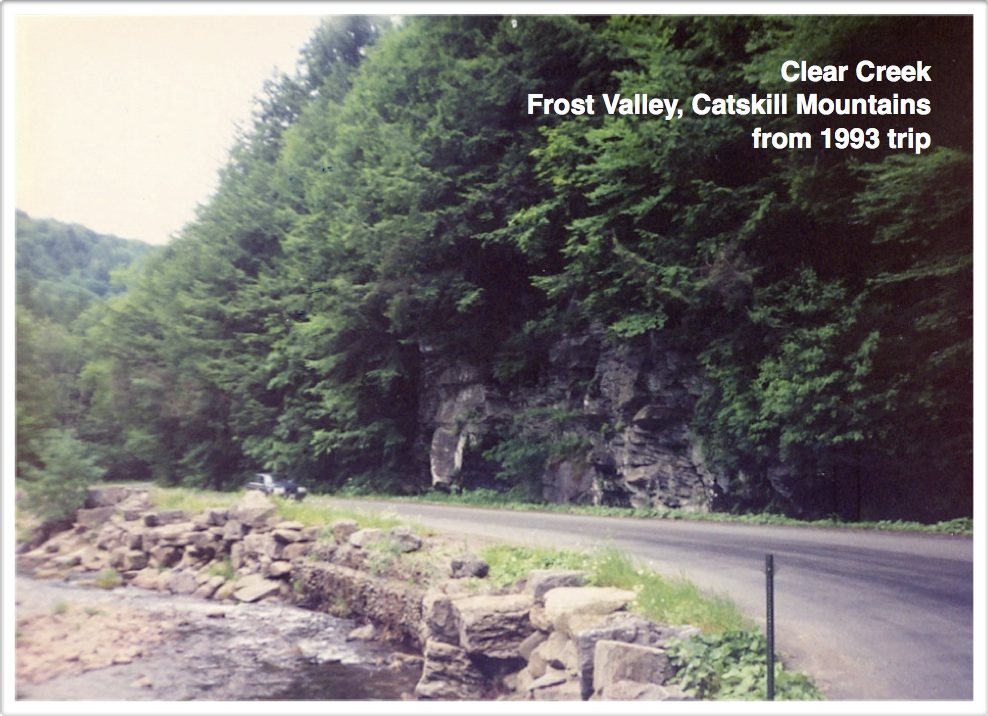
Clear CreekThe 3,000 acre private estate I was hired to help maintain for the summer of 1996 prided itself on being a fly fisherman’s retreat. Lovely Clear Creek flows through Frost Valley and there were several diversions from the stream into lovely little ponds that made perfect trout habitat.

The matron on the estate had long since grown too old to entertain the guests from the city who once flocked to the Catskill Mountains to escape the heat, so by 1969 about the only regular fisherman to tromp around the ponds was a seventeen year old grandson. When we first observed him bedecked in gear and trotting to the ponds, pole held high, the caretaker snorted something on the order of, “Behold the mighty fly fisherman. Fully capable of filling his creel in a pond stuffed with fish trained to feed when humans throw in food.”

Indeed, we did throw in the food. Even though there remained but one fisherman the ponds were maintained like the glory days, entirely overstocked for the food supply, so one of the first chores I learned was where the ponds were and just how many handfulls of pellets to cast upon the waters.

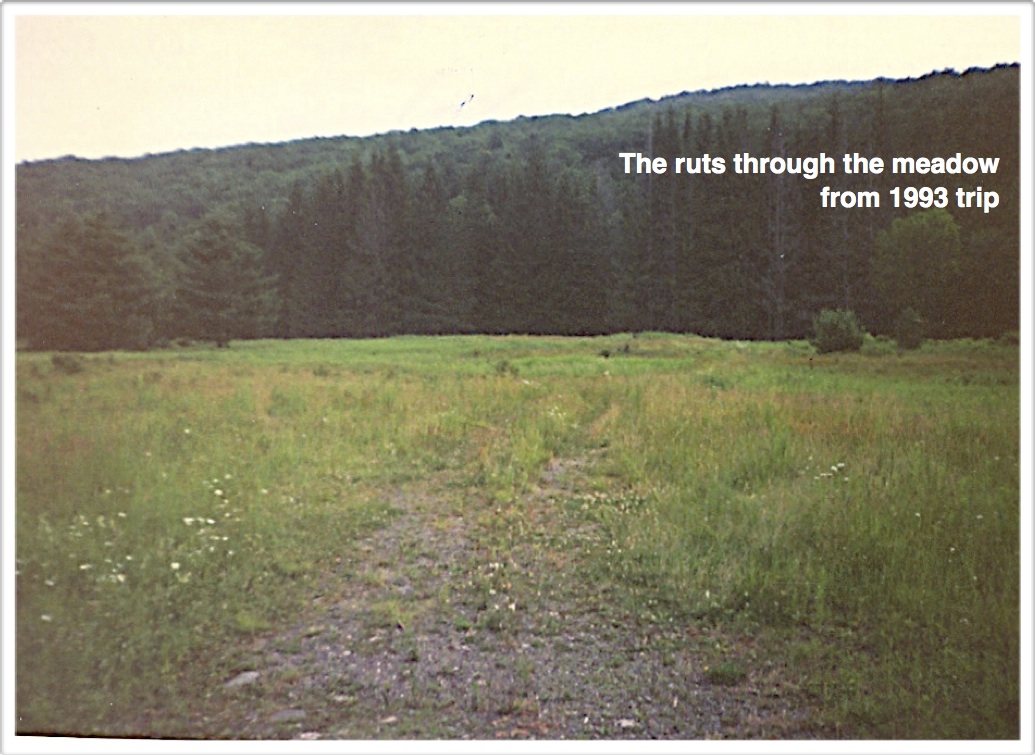
The primary fishing pond was a short drive up the valley from the lodge and set on the far side of a mountain meadow. The meadow had a two-rut path of a road arcing to the pond but we never drove on it. We’d just park the Scout by the side of the paved road and carry the bucket of food to the ponds.meadow

One lovely spring day (I almost said “One particularly lovely spring day,” but that would imply they were not all lovely. It was always a treat to walk through the ever-changing meadow) I glanced up from my admiring the flowers and grasses to find myself face to face with an undesirable critter.

Or should I say ankle to face? Some ten feet away and ambling toward me on the other side of the ruts through the meadow was a baby skunk. We both froze at the same moment. I stood still. After the slightest hesitation, he rather slowly and with great purpose elevated himself up on all four toes and lifted his tail.

I’m pretty sure a baby skunk, at lease one big enough to be ambling about on its own, can be just as influential as a full grown skunk and whether that is the truth or not in not something I particularly care to find out. Neither of us moved.

Given a minute or so, we both seemed to settle the question of who was out to do what and to whom and we both understood all either of us wanted to do was to continue ambling. I confirmed my intent by making a wide arc through the meadow on my side of the road. He turned on his toes, eyes riveted on this odd creature, until I was back on the path and headed on my way. I turned to see him figure I must be an OK dude before getting off his toes, turning his back, and continuing his journey.

I liked that baby skunk. And I hope he liked me. A very cool pole cat, indeed.

On The Road #14, Neversink

I woke to the racket of big rig trucks on their morning move across New York State. The expressway overpass that was my roof rattled under screaming tires and I figured it was time to hit the road.

I was headed toward a road through the heart of the Catskill mountains, a road respectable enough to earn a little black squiggle line on my map but not worthy of a number — just the notation Frost Valley. I enjoyed lovely little Route 55, winding its two-lane way through broadleaf forests and cleared farms between the overpass that had served as my tent at Liberty, New York, and Frost Valley. About half way between the two my map showed a community called Neversink.town new

The name caught my eye. A mountain town called Neversink? Had it once had neighbors that had sunk? Most curious indeed.

What I found was a lovely community of freshly painted houses. And a most poetic set of circumstances, indeed.

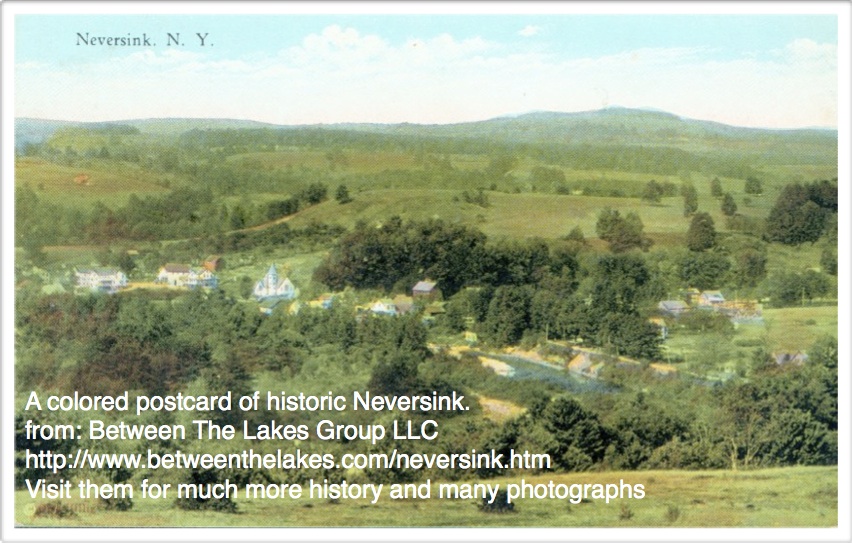
It turns out no one really knows the origin of the names Neversink River, Neversink Township and Neversink the town. There is speculation it came from in Indian word but that is disputed. We do know the town was established on March 16, 1798. And we know that, of all the towns and cities that have been established in New York State and these great United States, Neversink is one town that did, indeed, sink. It seems New York City, some seventy-five miles to the south, was thirsty.

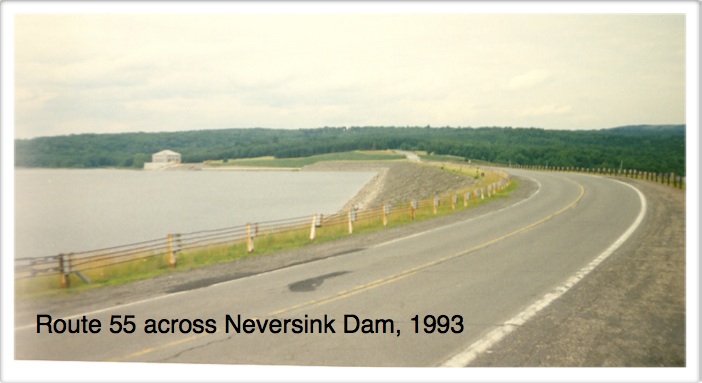
The city began looking for more water in 1941. Its first choice for a reservoir was shut down by squabbling over quality fly fishing, so the city dammed Neversink River instead. Today this reservoir joins three others in the area to supply half the city’s water. The reservoir was complete in 1953 and was supplying water at its planned capacity by 1955.town historic

And that’s how lovely Neversink the town was condemned to slip into the watery deep. Residents rebuilt about a mile away and above the waterline.

There was another community on the Neversink River that met the same fate but not the same end. It was never rebuilt and is lost to history. Its name? Bittersweet.

1993 dam top

1993 dam face1993 resevour