Author Archives: deansgreatwahoo

Unknown's avatar

About deansgreatwahoo

After graduating in 1964 I headed to Hollywood to be a movie star, only to drop into the '60s. Lucky me! After hitch hiking around the country from '69 to '72, I graduated from Boise State University and settled into waiting tables for a living and pursuing other interests—teaching stained glass at BSU, writing for Boise Weekly and Idaho Magazine, publishing some Idaho and Biblical history, acting in a few local shows, and traveling at the drop of a map. For two years I produced a half-hour public access TV show available at www.greatwahoo.com. In 2011 I was featured in Scott Pasfield's book Gay In America. Through it all I've come up with some stories and am using this blog as an excuse to get them written down.

On The Road #5, postmaster

I found myself in eastern Pennsylvania that spring of 1969, cresting a rolling hill, and facing a straight stretch of road cut through the encroaching forest. There was a light mist of rain. The cresting road rolled into a gentle downward slope, bottoming out some quarter-mile distant before beginning an easy climb. At the bottom of the slope it looked like there was a wide spot cut into the woods.

I had written a letter home every week since running off to Hollywood five years earlier. It never crossed my mind that living on my feet, walking backroads, and having all of six cents in my pocket might add up to an excuse to break the letter habit. In fact, I had a letter to send and had spent the day looking for a post office. It was getting late, just losing light. I had to find a spot to roll out my sleeping bag.

As I reached the bottom of the hill the wide spot in the woods expanded to include a building. That one building was marked, U S Post Office, Greentown, Pennsylvania.

It was at least five o’clock. Even so there was a lone person in the building, behind the counter and putting on his coat. Expecting a locked door, I was surprised when it gave way.

Yes, he was closing up.

But, sure, he’d weigh my letter and make sure the single stamp was adequate.

It turns out the letter was overweight. The rural postmaster looked me over, pulled out his keys, and unlocked his drawer to sell me a second ounce stamp. Fortunately my six cents were adequate, even leaving change.

I thanked him profusely, affixed the stamp, delivered the letter to the slot across the lobby, and began to leave. One final turn to say thanks. We acknowledged one another and hesitated.

“Did you just mail a letter to your folks?”

“Yea.”

“Are you just passing through?”

“Yes.”

“Would you like a place to spend the night?”

I beamed.

His home could not have been more cozy. His beautiful wife stretched dinner to include an extra place at the table. The conversation was lively, with questions about Boise and Idaho, which he had notice on my letter. We spoke of hitch hiking and adventuring and the lovely forests of the eastern United States, something his two daughters had not considered.

After dinner I insisted on washing the dishes to say thanks, despite the postmaster’s insistence that his daughter’s chores covered that. While mom and dad rested in the living room their junior high-aged daughters could not get enough, more than happy to help this tall stranger from the mystery of the road who had taken over their nightly chore.

After dishes I joined the conversation in the living room where we became more intimate. The daughters, it turned out, had an older brother—a brother who was fighting in Vietnam. The fight that was tearing the United States apart. The fight I was not participated in.

“We worry about him, of course,” the postmaster said. “We hope if he needs help someone takes care of him. So I couldn’t leave you outside tonight.”

That night I lay, warm and dry in their son’s bed. A photograph of him in his dress uniform was on the corner nook, watching over me.

For one night this empty room in a loving family’s home had the sound of breath. I hope their son slept as soundly as I did.
On The Road #4, sunlight

I don’t remember. This day might have been in northern New Jersey, but I’m pretty sure it was eastern Pennsylvania.

I do remember I had 6¢ in my pocket, which had been a carefully considered decision. In those days, to pick up a pay phone and talk with an operator to make a long distance call you had to insert a dime. After you’ve found someone to ask what a “pay phone” or a “long distance call” is, I’ll continue my story —

After buying a much-needed toothbrush and feeding myself for several days, I found myself with a few coins in my pocket. To even buy a can of kidney beans I had to break my last dime. I had the choice between something to eat and a last chance to call home asking for help to get off the road.

I left the little country store with 6¢ and a can of beans.

Those six cents were on my mind that afternoon, as I passed through lush woods and farms, but there was not much time for obsessing. The air was so fresh. The winding country road was so inviting. And the springtime mist was often sprinkled with moments of glorious sunshine. The gray of the sky would part into brilliant blue and billowing white. The wet greens of springtime earth would sing in vibrant, crystalline light.

About two in the afternoon a bit of straight road was wet and sparkling in the sunshine. An old wood fence on my right offered a place to sit and ease the cotton sleeping bag off my shoulder. Across the road another wood fence separated the grass next to the road from the grass in a pasture—all glowing in the light and just hinting of the color of budding flowers. Rolling hills gave a weaving distant edge to the pasture, covered in gray trunks of trees, topped with yellow and ruby red branches just filling with life.

A few seconds? Ten minutes? Thirty?

Even now the sunshine and the air and the color and the being of it breath through me. So beautiful.

And, like now, the time came for a different slant.

I was past hungry, having tried to save the beans for when they were really needed. Leaning against the fence I opened the can and found my spoon and savored nourishment that was as preserved as the air and the light were spontaneous. (Although I didn’t think of that until now. At the time I only thought how luscious those beans were.)

Half way through the beans I decided to save the rest for dinner. There was no putting the lid back on those sticky beans so I stuffed the open can in the top of the roll of my sleeping bag where it would be held upright.

I licked the spoon clean, put it in my pocket, and kissed that lovely moment and that beautiful, sun-lit space, Thanks.

On The Road #3, water

I hit the road walking north from Princeton, New Jersey, in the early spring of 1969. I didn’t think much about carrying a heavy, WWII surplus, cotton-stuffed sleeping bag my aunt and uncle Celesta and Paul Huff had given me. A long coat of heavy wool was just a coat. And I didn’t hesitate to tote along a seven-pound wooden box of artist’s paints. 

But I was concerned about weight so decided not to burden myself with a toothbrush. 

Opps.

It turns out fingers make bad toothbrushes, no matter how vigorously one squeaks them across one’s enamel. Although I was avoiding major highways and cities, I did regularly pass through small communities. The first one I passed through on my second day on the road is where I spent a bit of my limited financial situation on a delightful device to brush my teeth. No toothpaste—too expensive and too heavy. But the brush? You bet.

One thing I did not lack for cleaning my teeth was water. 

It was springtime in the hills of northern New Jersey and eastern Pennsylvania. Snow was melting so any brook was a stream and the streams were small rivers. But these waterways were difficult to get to, often running with steep banks covered with wet grass—a trap just waiting for a hapless hippie, heavy with packs, to slide into. The easily accessible, gentle slopes and sandy beaches on these high-water streams were all tucked well behind the Private Property — No Trespassing signs that were posted on every other tree.  

Compared to the snarling dogs of the snow-fed streams, I found water that was as pleasant as a  flicking finch. It gently rushed in small rivulets, usually through grass but sometimes gravel. It was clean as polished crystal in sunshine, cool and fresh, and available within a few feet from everywhere my feet fell. 

This water had just fallen in the misty rain that filled the days and nights. It was often an inch deep, a few inches wide, and always running swiftly. It was the water beside the road, running between the roadbed and the cuts that had been graded through the hills. 

I had always lived in deserts. My mountain hiking had been where rushing streams were few and far between, and then possibly polluted. These roadside rivulets of rain-fresh water were new to me. 

I may have been damp and cold, sleeping in this springtime weather without a tent. But to this day I remember how lucky I was to enjoy those fresh, abundant, and pleasant sources of beautiful water.

On The Road #2, New Jersey lessons

The New Jersey countryside was wooded hills and just-greening farms when I lit out from Princeton in the spring of 1969.

After a day of walking north on an obscure road the light began to fade and I started to look for a spot to sleep. The fields were too muddy and I wouldn’t have wanted to irk the farmers anyway. The forests were posted as private property with emphatic No Trespassing instructions.

It was all a quandary and getting darker when I saw smoke from a campfire across an abandoned field. There were a couple of young guys at the fire and they seemed to be waving me over. After some Who? Me? gestures I walked across the field, perhaps some two blocks distant from the road, and took my shoes off to cross a stream running swift and very cold from the spring thaw.

The guys turned out to be high school buddies enjoying a favorite camping spot. The stream I crossed was joined by another just west of their camp, making a tip of land caressed by the sound of rushing water. Complimenting the noisy atmosphere were all the amenities a young men’s camp needs— A few rocks to sit on. A campfire. A small tent. A few pots and pans. And a brand new electric lantern, the most modern kind available, with a short length of florescent bulb meant to light the entire camp. A vast improvement over flashlights.

I rolled out my sleeping bag beside their tent, confident it wouldn’t rain. The darkness gathered. Soon we were in a cocoon of flickering campfire conversation.

Then I hear a thud. Before I had time to think a thud in the night was rather odd my camping companions were on their feet, the florescent light was out, and a rusty stick of metal had materialized from their tent. I soon realized the rusty stick was an ancient BB gun, long since having lost its wooden stock but still perfectly capable of being pumped and shot.

As BB pellets volleyed into the darkness rocks began to rain into our campsite from several directions across the two streams.

“They better not break my new lantern,” was the only concern I heard as the two New Jersey campers grabbed the device and told me to follow them, still shooting blind into the woods. We retreated some hundred feet before they turned and said we’d be OK, “The rocks cant’ get this far.” Apparently the BBs could since pellets kept being pumped into the darkness.

The next morning we broke camp and the shooter insisted he carry me across the cold stream. It was awkward, me being a half a foot taller, hanging onto his back. The two guys walked off through the field headed southwest and I was just heading north when I saw the rusted stick of a BB gun where it had been dropped in the grass. I picked it up and called out. They were glad to have it found and I was glad for an adventurous camp.

And that’s how I learned two things. First, a highlight of New Jersey high school camping was waiting for your buddies to sneak up and throw rocks at you. Second, it certainly was wise to find a camping spot where swift, cold motes are too dangerous to cross in the dark.

On The Road #1, a regret

This account from my hitchhiking days includes a reference to encountering the scary Las Vegas police. For that story see Cops while hitchhiking #2nevadaPhoto

Shortly after my encounter with the scary Las Vegas police I got a ride with a trucker pulling an empty flatbed trailer. It wasn’t long before his destination pulled him off U S Highway 95 and I found myself with the sun setting in a very small desert town. There was one intersection, a convenience store, and a spattering of homes.

The prospects of getting a ride looked rather bleak.

I walked across the intersection, looked back to see the truck turn and pull away, and then noticed a lone sedan pulling through the intersection in a most hesitant way. Two guys about my age checked me out as they drove past. They pulled over and stopped.

It turns out they were on an adventure of their own. On their road trip they had given a guy a ride who had ripped them off. They had no money and were trying to get back to Oregon.

I did have eight bucks or so, enough for a tank of gas in an American sedan back in 1968. We filled up and headed north toward Boise. They were very cool, fun, good looking guys.

It got good and dark before the first driver suggested his buddy drive for a while.

A tank of gas was less than eight bucks back then and seat belts were an option most cars did not have. As the first driver laid across the back seat his buddy grinned and observed, “I know what you’re going to be doing back there.” The first driver admitted he had not given up driving because he was tired. Rather, he was horny.

Talk about an opportunity dropped in my lap! I opened up to them that I was gay and loved to give guys blow jobs. They didn’t freak out about it. Just then the Beetles’ new hit came on the radio, Why Don’t We Do It In The Road . . . 

Now, I know, dear reader—I must be the only guy (and we can probably include you gals here, too) who looses his cool when sex comes knocking on my window of opportunity.

I’m still convinced we could have done it in the road all the way to Boise. But my tendency to find excuses and make conversation and keep myself avoiding what I really want kicked in. I babbled and babbled, lost in my own assumptions of other’s being uptight about enjoying sex when, really, it is I who gets upset and mindless when opportunities present themselves.

Yes, I do forgive myself for being human and I tell myself I probably share this frustration with most of humanity. But darn it. When am I going to stop and pay attention instead of go in automatic find-an-excuse-not-to mode?

My greatest regrets are not for the mistakes I’ve committed, my friends. They are for opportunities I turned my back on.

Why Don’t We Do It In The Road, indeed.

Cops while hitchhiking #4

This is the fourth of four stories about my dealing with police while hitchhiking from 1968 to 1971. 

For the story of my third encounter with the police, which happened in the day before this one, see Cops while hitchhiking #3 

When I lit out hitchhiking from Princeton, New Jersey, toward New England in the spring of 1969 my objective was to avoid traffic. It seemed best to head to the north and pass well out of reach of the biggest traffic snarl of all: New York City.

So it was I found myself heading toward my fourth encounter between an Officer of the Law and a rumpled highway hippie.

Checking out a map I noticed a large green area well above the city, marked as the Catskill Mountains. Vague references to the Catskills swam somewhere in my memory but the real attraction on the map was the lack of towns in this large area. Plus, there was one very little black line jagging through it. I checked and sure enough, that little black line was the smallest road this map bothered to indicate. Tiny letters labeled it Frost Valley.

It was April, I was cold, and one would think an area called Frost Valley would sound better in the heat of summer. But I could not resist that little black line on a map.

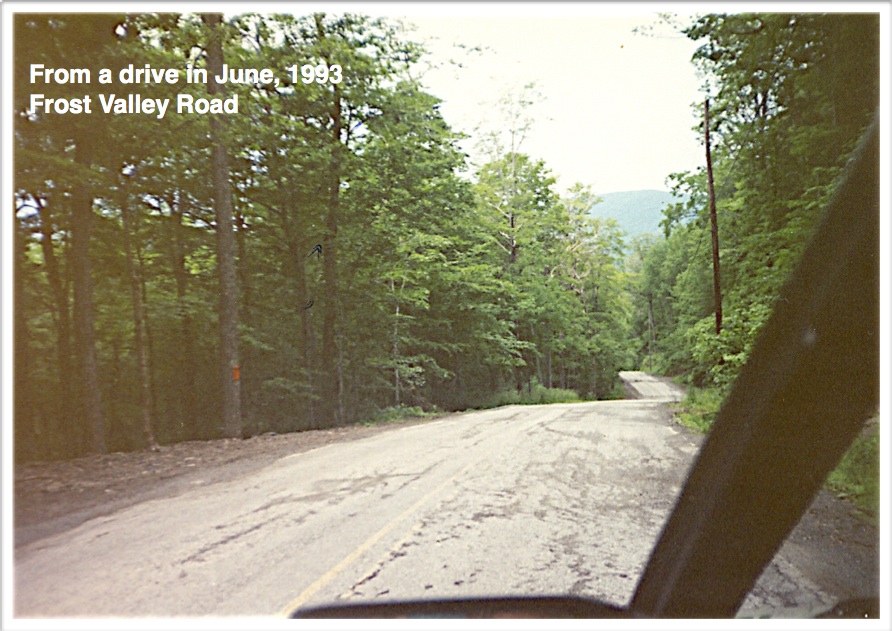
FV road #1I loved it as soon as I stepped onto the Frost Valley road. What was a little black line on the map was simply a little black line on the ground. There were no painted lines. Whenever a tree was in the way or a rock outcropping got close the road just narrowed itself around them. In the West this would have been an unimproved dirt road, but New York is more populated than Idaho and here the road was coated with what I learned was called grader mix—a process where gravel is piled down the middle of the road, thick tar is mixed into with a road grader pushing the combination back and forth across the road, and the mixture is then flattened across the road and rolled into a macadam surface.

FV road #2It was heaven—spring hardwood trees and shrubs, just leafing out, crowding up to and pushing over the road. Ferns coating the ground under the canopy of the forest. Small waterfalls splashing down an occasional steep hillside beside the road. A clear mountain brook gurgling and babbling beside it all.

It was all new to me, being from the dry pine forests of the West.

Also new to me were the Private Property — No Trespassing signs. Idaho is 60% owned by We the People of the United States. I was not familiar with every fourth tree having a paper warning sign on it. What was this having to stay on the narrow strip of land between Private Property signs and the edge of the roadway? But stay there I did! Far be it from me to attract the dangerous, hippie-hatin’ cops.

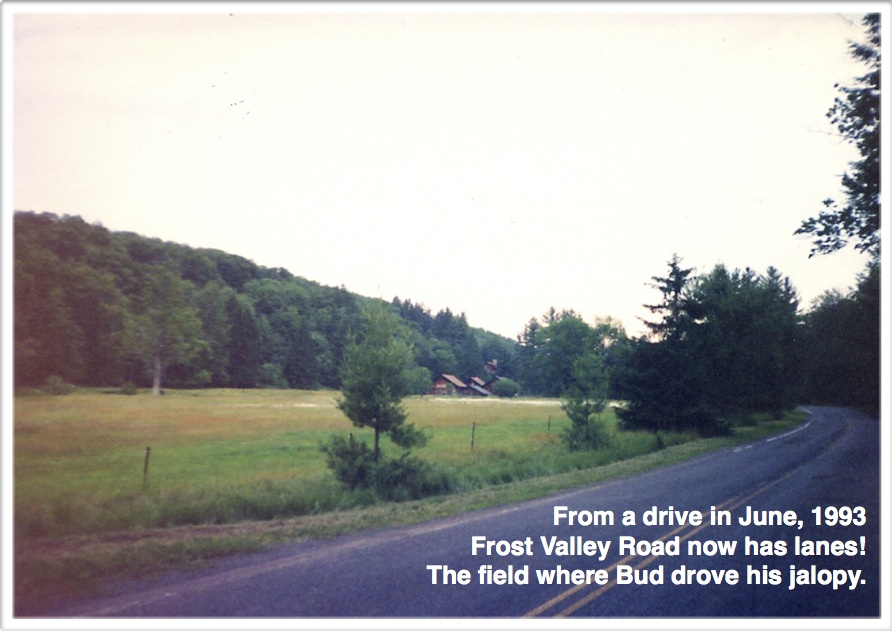
Wintoon lodgeI was several miles into the Frost Valley road and the light was starting to fade when a large Suburban filled with kids passed by. A minute later I came upon a wide spot in the valley with several buildings set back from the road, a mown field separating us.

A spunky kid must have gotten out of the Suburban and just made it across the mown field, where I saw him drop his books and jump on a jalopy that was little more than a motorized frame. He drove the contraption right to me.

He could not have been more enthused to meet a real genuine hitch hiker. I couldn’t help but really like this sparkle-eyed smiling bundle of enthusiasm.

The kid mentioned his dad might need some help with spring cleaning and I decided perhaps I’d go back a hundred yards or so and find a place to sleep. A place where the tree holding the Private Property sign was far enough off the road so I could wedge myself between trespassing and sleeping in the road.

The next morning I heard the Suburban pass, a load of kids headed to class. I rustled myself and brushed my teeth in the water running beside the road. I finished off my last half a can of beans. My toothbrush was tucked in my pocket and I was just getting the rope cinched around my sleeping bag, all dallying enough so the kid’s dad might have a chance to come find me.

Then I heard the Suburban headed back up the valley. I looked up as it slowed to a stop. In the right hand front window I saw the sign, CONSTABLE.

The dangerous cop got out with a grin on his face. His son had told him about me and he’d been glad to see me camping beside the road that morning. And sure enough he could use some help since the hired hand from the last several years had moved away.

Would sleeping in the den, eating with the family, and a buck fifty an hour be OK for a few weeks of spring cleaning?

I spent the summer.

Cops while hitchhiking #3

This is the third of four stories about my dealing with police while hitchhiking from 1968 to 1971. For the story of my second encounter with the police, which happened in Las Vegas, see Cops while hitchhiking #2 

One hundred miles north of New York City, State Highway 52 spent twenty-five miles winding its way from the Delaware River to the town of Liberty, New York. They were beautiful miles, neat farms tucked into hardwood forests on a casual, small, two-lane country road. Just what my hitchhiking soul was looking to travel.

Even though avoiding freeways was an aim of my travels, on this particular day I was trying to make it to Liberty just because it had a freeway passing by. Freeways mean substantial bridges. It was early spring and we can thank rain for the lush green of eastern forests. I was looking forward to a dry spot to sleep.

I walked beside the narrow road without sticking out my thumb, thankful if rides were offered but not soliciting the attention of authorities. Besides, were I was going was exactly where I already was—hitchhiking America’s byways. One is not in a rush when one is already there.

The countryside passed at the pace of a mosey.

A couple of miles before Liberty there was a bluff I’d have to climb. The road bent to the left and became a steep grade, cresting the bluff with a sharp right turn some hundred feet above the valley I was walking. My fear was the grade was probably cut as shallow into the hill as possible to save costs, and my fear was right. As I approached I saw the road narrowed even more.

The steep grade had no room on either side of the road. I could balance on top of the guardrail to the left, stumble over the steep loose dirt on the right, or walk on the road.

A dangerous situation, indeed. The road up the grade was narrow enough so cars had barely enough room to pass one another even without a pedestrian to get around. The grade was long enough so no one would want to stay behind me for the length of it. The grade was short enough so oncoming traffic could appear at the top of the hill with precious little time to stop for a car passing me. And, most dangerous of all, if there was anywhere a cop would stop me for walking on the road, this would be it!

But there was nothing to do. I quickened my pace, stepped into the road, and started scooting to the top.

I hadn’t seen a car in miles and I hadn’t seen a patrol car in three days. So, of course, when I was half way up the hill and in the narrowest part of the road, what should appear at the top of the hill?

You, dear reader, are an excellent guesser.

The officer was alone, rather young, and began slowing as soon as he saw me. He stopped next to me, no room to pull over, set his brake, and started to get out. Even while he was opening the door he began expressing his concern about my walking on the road and especially in this very dangerous spot. I told him I agreed completely, was doing my best to get to past this very dangerous spot, but I had no choice since there were no rides. Along with my words of agreement there was a sincere laugh of admitting he and I could not agree more.

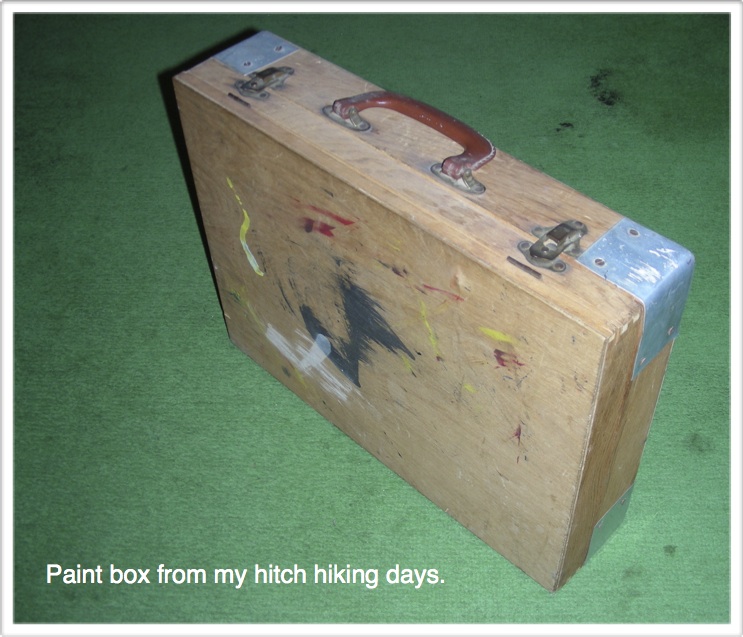
As I remember he asked what I was up to, to which I replied I was out adventuring and a little road through the Catskills was the perfect place to be. By his fourth sentence he asked a question I remember well: “What’s in the box?”paint box

It was a wooden box, exactly the kind painters carry their paints in, and that’s exactly what I told him was in there.

“Oh. Those are my paints.”

He jumped in, “Do  you work in oils or acrylics?”

“Oils.”

He gushed, “How do you get the paints thinned? I’ve just started painting and the paints are too thick when they come out of the tube!”

(This hippie instantly stopped worrying about a big, bad cop hassling hitch hikers!)

I told him about linseed oil and volunteered to show him, waving my box around looking for a place to set it. He motioned to the trunk of his car and I said I didn’t want to scratch it but he indicated that was the last of his worries. So I gently put the box on his car, popped open the lid, and showed him what to look for. cop saw

We both knew we were blocking the road, so he soon thanked me and told me he was sorry—he wished he could give me a ride to Liberty but unfortunately he was heading the other way and had somewhere to get to.

I scooted to the top of the grade, the curious cop being the only vehicle I encountered on the climb.

Cops while hitchhiking #2

This is the second of four stories about my dealing with police while hitchhiking from 1968 to 1971. 

Oddly enough, it was not until I wrote these first two stories that I realized the two very first encounters I had on the road were with lawmen. 

For the story of my first encounter with a policeman, which happened earlier the same day as this story, see Cops while hitchhiking #1

Advice was abundant when I was about to start hitchhiking—mostly about how bad all cops are to vagrants. But one town’s cops were pointed out to be the worst of the worst. The pit of repression. The hell hole of cops having no place for street people.

This town’s name was Vegas.

Now, perhaps my friends had special warnings about Las Vegas just because they knew my maiden journey was bound to pass through it as I made my way from Twentynine Palms, California, to Boise, Idaho. But their reasoning was persuasive enough—Vegas was about money and spending it. Someone without money was useless. It was the cop’s job to make sure the penniless did not feel welcome.

I had hoped to get a ride through Las Vegas but my ride from the south needed to report to an office near the Strip. I decided it was best to avoid the crowds and cops of that particular slice of humanity so I got out as he turned off U. S. Highway 95.

Highway 95 passed east and north of the Las Vegas Strip on that December afternoon in 1968. At the time it was on the edge of town but still developed enough for sidewalks. I dutifully kept to the walkways, watching the impressive Sands Hotel slowly passing in the distance to the west.

It took a couple of hours, walking past Las Vegas.  My WWII-issue cotton sleeping bag was heavy on the rope over my shoulder. My wooden box of paints was heavy in my hand. A bag with food and a toothbrush flopped around my waist. I wasn’t a snappy hitch hiker but but all was well.

Finally I was rounding the long curve Highway 95 took around the north of the Strip. Another mile or so and I’d be far enough on the edge of town to stick out my thumb.

I was half way through the curve, approaching an intersection, when a Las Vegas Police cruiser slowed to take a look. It turned at the intersection and I watched as it made a U-turn and parked on the side road.

So much for avoiding the Las Vegas cops.

I was just entering the intersection as they stopped, so started walking toward the cruiser. I checked to be sure my Boise for Xmas sign was visible.

Two officers got out. The driver did the talking. “Heading to Boise, huh? Don’t you have enough money to get a bus?” I replied I might have enough to make it from Las Vegas but I’d like to save it for Christmas.

A few other questions and the officers seemed content I was not a threat to the community. They wished me the best and agreed that before long I’d be far enough out of town so the traffic would thin enough for hitch hiking. I thanked them and turned to walk the few steps back to the highway.

Then I heard the driver yell out, “Hey, buddy …” My stomach sank.

Both cops were standing behind the open doors of their cruiser. The driver was swinging his arm as he yelled out, “You can probably use this more than I can.”

It was tumbling in a high arc and I instinctively caught the gigantic Hershey bar. No almonds.

Cops while hitchhiking #1

Advice was freely given long before I set a date to begin hitch hiking. The words of discouragement ramped up as the date came due. 

You might think the advice was centered on the dangers of unscrupulous motorists, but this was 1968. More than half the advice I heard was to watch out for cops. Cops don’t like hitch hikers. Hitch hikers have no money and nothing to offer and it is the cop’s job to be mean so they keep moving on. Being young and not in the military I’d be a hippie for sure and the cops would just as soon beat up a hippie as go to their kid’s little league game. Amboy Road

With such concerns I set off from Twentynine Palms, California, where I’d fallen in with a military widow. Barbara insisted on driving me to U S Highway 95 and I was glad for the ride over long, straight, and mostly deserted Amboy Road and then old Highway 66. In those 101 miles we may have passed five cars. 

Today Highway 66 is Interstate 40 and I’m thinking the sound of tires on pavement is pretty prevalent where U S 95 takes off to the north. But a few days before Christmas in 1968 it was a sandy spot in the desert with two small paved roads, one running east and west and the other taking off to the north. And that was it. Barbara’s Cadillac grew smaller on the horizon. The wind blew. 

Barbara’s car had been out of sight for some ten minutes before an older gray sedan approached from the east. Low and behold, it slowed and turned north. My Boise for Xmas sign was in the air. I got my very first ride. 

Within five minutes the rather rumpled driver had told me he was a cop. 

A Federal agent, actually. Out on a reconnaissance mission. “Did you notice one of this car’s windshield wipers is missing?” he asked. (Actually, the only thing I had notice was I had a ride!) “It also has no front license plate. And my side mirror is busted. In fact, there are lots of things wrong with this car. I’m out here to see if any of the state or local police find any of these problems. That is, if they even stop me for no front plate or the busted tail light.”

It was the only time I’ve been in a car while looking forward to being pulled over, but I didn’t get a chance to watch this guy in action. We pulling into the south side of Las Vegas with nary a slow-down. As we approached the city he said he had to stop at the local office and report. He apologized, “there are rules about not picking up hitch hikers on duty, so I have to let you out.” I thanked him for the ride and the great chat. 

And that, my friends, was my first run in with a big bad cop. It got me 95 miles and some stories about how easy it is to overlook absent windshield wipers.

The day would not end before my second run in, this time with two big bad coppers