Author Archives: deansgreatwahoo

Unknown's avatar

About deansgreatwahoo

After graduating in 1964 I headed to Hollywood to be a movie star, only to drop into the '60s. Lucky me! After hitch hiking around the country from '69 to '72, I graduated from Boise State University and settled into waiting tables for a living and pursuing other interests—teaching stained glass at BSU, writing for Boise Weekly and Idaho Magazine, publishing some Idaho and Biblical history, acting in a few local shows, and traveling at the drop of a map. For two years I produced a half-hour public access TV show available at www.greatwahoo.com. In 2011 I was featured in Scott Pasfield's book Gay In America. Through it all I've come up with some stories and am using this blog as an excuse to get them written down.

Atlanta ID to Alturas Lake #2

INT

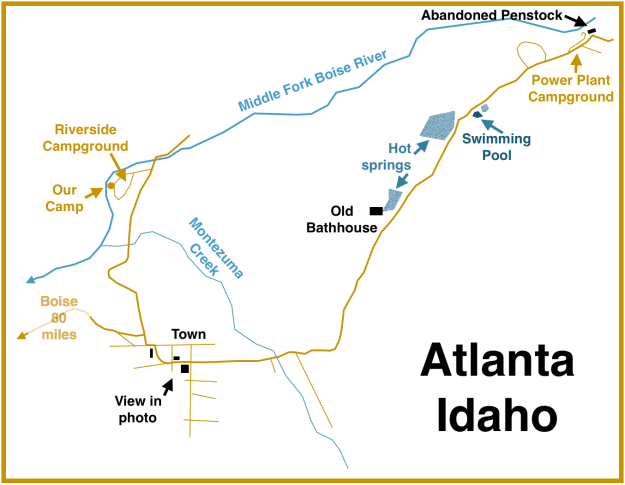
After packing our horses on that Atlanta morning in 1954, we found ourselves walking the entire operation up the familiar road to Atlanta.

Atlanta was a virtual ghost town even then, so probably no one noticed Mom and Dad and we three kids and three loaded horses, but we did our best to provide a parade for anyone interested in watching.

After the few buildings of Atlanta we walked past the Forest Service bath house, fed with hot springs, and a short bit later the swimming pool, also fed by hot springs. Back in 1917, when he was fourteen, Dad and his school buddies had kicked the mud up from the bottom of this pool when the schoolmarm walked by. The mud made a good curtain to hide their skinny dipping from such a pretty authority figure.

Pool INT

I knew what that warm mud felt like between my toes. Returning to Dad’s youthful haunt had filled many an evening on our summer camping trips. The crisp air at 5,500 feet, the warm water, the mossy mud and the smell of pine trees were all one Atlanta amalgam.

But this time we didn’t stop for a swim. We just kept walking. Past the rusting penstock of an abandoned powerhouse. Past the upper campground we never stayed at. Along the deteriorating wooden flume that had run water to the penstock. Then we crossed the green-clear rushing water of Leggit Creek on a most precarious bridge of barely more than logs laying on rocks.

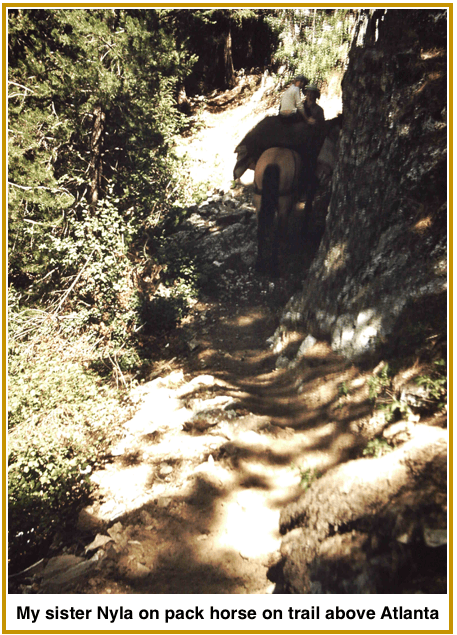
Then the climb began. A steep and rocky and dusty climb in my mind. And tiring. Before long I had been hoisted up on one of the pack horses to ride (What? A nine-year-old whine about walking uphill? Pshaw… I’m sure the horse just needed more weight).

Folks, to my mind it was a long way up to the back of a horse. Add another yard or so because of pack boxes piled over with blankets and tarps — blankets and tarps I was sitting on that left no room to reach my legs around!

Way down beneath it all was a steep slope littered with rocks to bash my head on should I fall off.
Nyla INT

Well. I was one very attentive boy and my knuckles turned whatever color they had to while my hands gripped the ropes that cinched the awkward mound on a swaying and bucking perch!

But I didn’t ask to get off and walk …
Atlanta ID to Alturas Lake #1

I was nine in the summer of 1954, the year mom and dad took on the task of herding three kids and guiding three horses over our first trek through the Sawtooth Mountains of central Idaho.

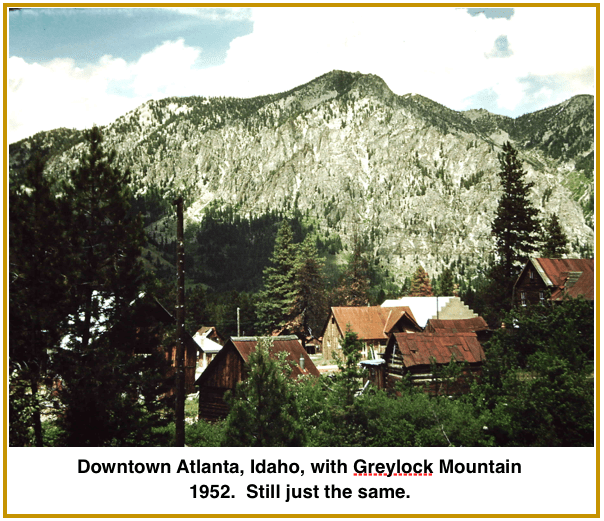
Atlanta, Idaho, is some eighty miles from Boise, up a very rough road along the Boise River. Dad was thirteen years old when he first saw Atlanta and his mother ran a laundry there until he was fifteen. He loved the rugged mountain setting of towering peaks and rushing cold water, all sprinkled with hot springs here and there.

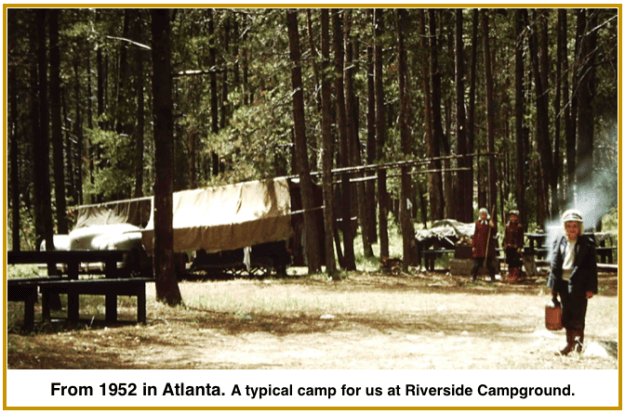
Atlanta 1952 INT

By 1954 we had camped in Atlanta several times, so I didn’t think much of yet another summer vacation in the remote reaches of Idaho.

Atlanta camp INT

The first hint of this being an unusual camping trip was Dad talking with locals about horses. And then having horses in our camp while we loaded wooden boxes with raw potatoes and cans of food and our Coleman camping stove and a can of white gas for the stove and pans and can openers and knives and matches — only to double check and check again that we had everything.

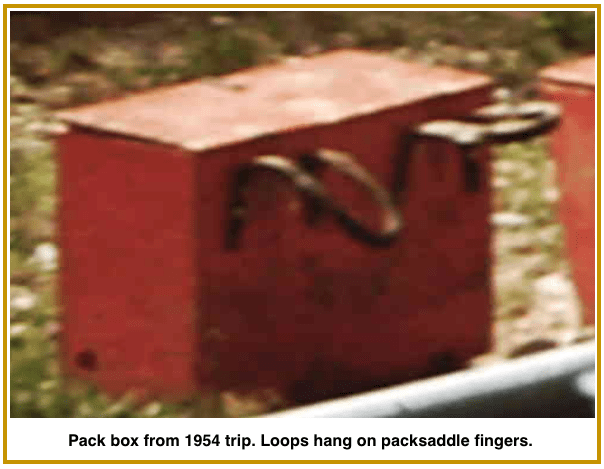
Packbox INT

Then, next morning, dad put what looked like small sawhorses on the backs of the horses. The sawhorses were called called packsaddles and had little legs that stuck up from them. Where these legs crossed made a notch to catch rope loops — rope loops that were attached to the wooden boxes holding our heavy 1950s camping gear.

Packsaddle INT

Photo: A special thanks to Trailhead Supply of  Kalispell, Montana.

Mom and Dad were careful to make sure the weight of each box was real close to the weight of the box on the other side of the horse. Then they mounded the loads ever higher with quilts and canvases thrown over the tops of the boxes and the backs of the horses. Finally the entire kit and caboodle was secured to the packsaddles with ropes.

My beautiful picture

And we were off !

Frost Valley #14: Back to Bud

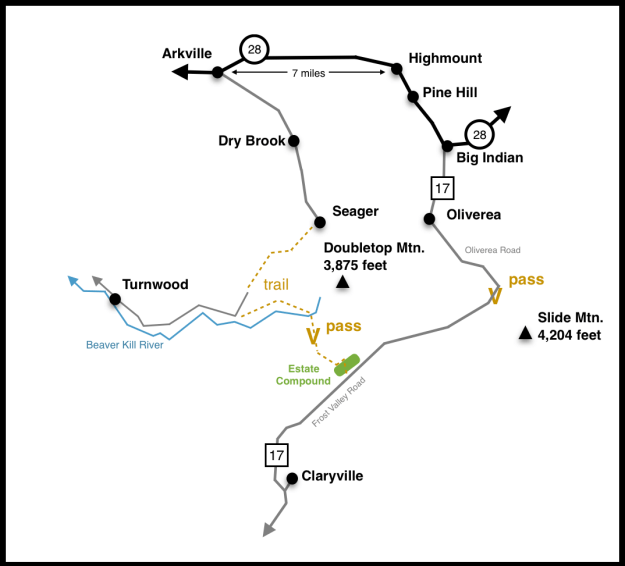
I don’t remember Seager or getting out of the car or what the beginning of the trail looked like. Nor do I remember crossing the headwaters of the Beaver Kill river. But I do remember snippets of a beautiful springtime path cutting its way through mountain meadows and hardwood forests, fresh in the bright green of new leaves.

I remember the path — just wide enough for a single pair of legs and largely obscured by the tall grasses and wildflowers crowding in on both sides.

And I remember a particular wide opening in the forest with dead timber and boggy ground where the gentle climb eased over a generous hump and began to descend.

I was not sure where the path was descending to. It was all a guess, taking off on this path having seen no map that showed it. But it seemed to be going in the right direction. And it was a path so it went somewhere. If it petered out I could always turn around.

It was a path with no footprints, so it could have been an animal path, but that never crossed my mind. The path had started at a road. It would come out somewhere and I could figure out where to go from there. It made no never mind to me where the path rejoined civilization.

In the meantime it was getting dark so I unrolled my cotton sleeping bag and ate a can of beans and crashed, glad it was the middle of May and not nearly as cold as the nights I had spent beside the roads in March and April.

The next day the little path continued to reveal itself — all running downhill. About noon I recognized the tree stump Bud and I had sat on chatting. I walked by the big old barn. Just past the barn I opened the door to their house and joined Stan and Lola for lunch.

Screen Shot 2016-01-28 at 8.05.27 PM

Frost Valley #13: Two Fun Gals

When I hung up the phone in Pine HIll I was mostly thinking about returning to Bud and Stan and Lola and the estate I had left in Frost Valley.

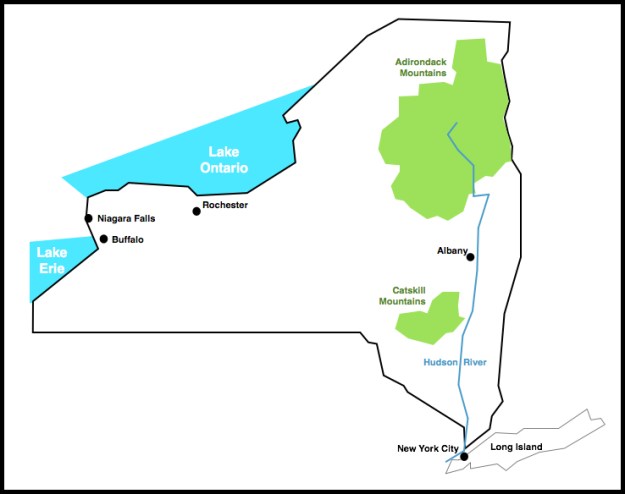
When at the estate, Bud and I had often walked up the rutted road that ran between their house and the hillside. Just a few yards past their house the narrow road passed a big old barn before turning left, into a gully that led into the hills. The road became two ruts and the two ruts gave way to a visible but not-well-maintained path. Stan had said the path went all the way over the ridge and through Catskill Mountain back country. Several times Bud and I sat on a stump where the road turned to path, visiting and enjoying the day.

As I returned to the road from the pay phone at the Pine Hill gas & grub, I decided to take the long way back to Frost Valley and see if I could find that little path that came in behind Stan and Lola’s house. I knew I had to keep going north and east and eventually drop south through the forest, but my map showed no paths.

I wish I could remember the names of those two spunky gals who picked me up as soon as I crossed the gas & grub’s parking lot. I thoroughly enjoyed their company and they seemed to enjoy mine. I’m guessing they were in their late twenties or early thirties and only as I write this have I thought perhaps they were looking for something other than a little daring-do, picking up a lanky hitch hiker to chat with. I’m so gay I miss all kinds of signals from the ladies, I’m sure.

Oblivious to anything other than friendly folks who seemed chatty and interesting, I told them about returning to Frost Valley and my decision to return the long way, hopefully on the little path I had been told crossed the ridge and led to the estate.

The gals looked at one another and agreed it might be the path that takes off from Seager. “At least it heads in that direction.”

I encouraged them to let me out whenever their route took off from mine and just point me in the right direction, but they would not hear of it. Rather, they insisted they take me to Seager and point out the trail.

to Segar INTI became most thankful for their insistence. Seager, it turns out, is a once-active village that died with the tanning business. With just one home, I would probably have been carrying my heavy cotton sleeping bag some nine extra miles. And then I don’t know if I would have found the tiny path.
Sawtooth Kidhood #1

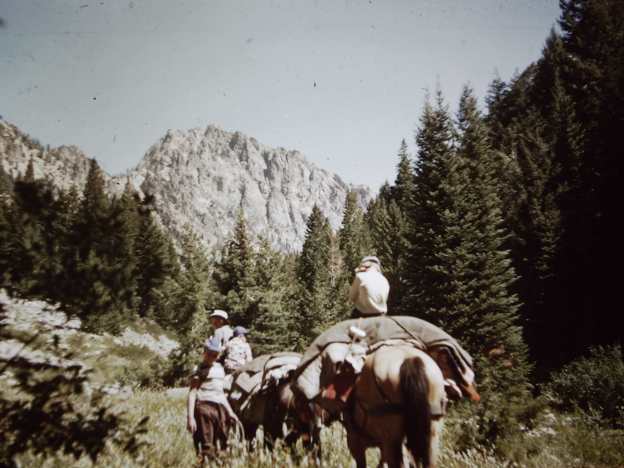
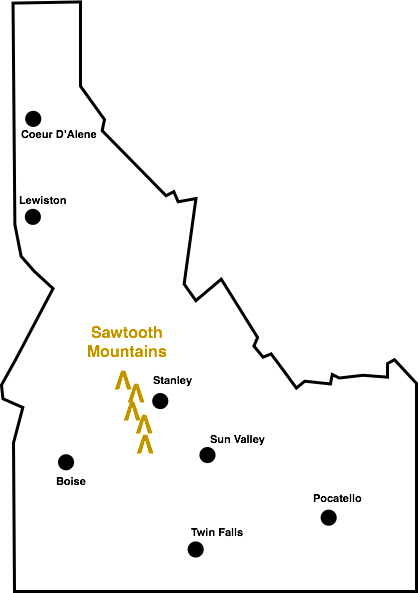
I was a kid in the 1950s and have always assumed everyone raised in Idaho spent every summer being drug over the Sawtooth Mountains with two or three horses in tow.

Sawtooths MAP INT

Mom and Dad rented horses for our annual Sawtooth walk-about. Light-weight sleeping bags and cooking stoves and dried food were in the future. To cook in the wilderness we carried iron skillets and a Coleman white-gas camping stove. Food was in cans and bottles — and, yes, fried Spam and cold Vienna Sausages on crackers taste mighty fine in the mountain air, all dusty from the trail. Or at least they did when I was ten.

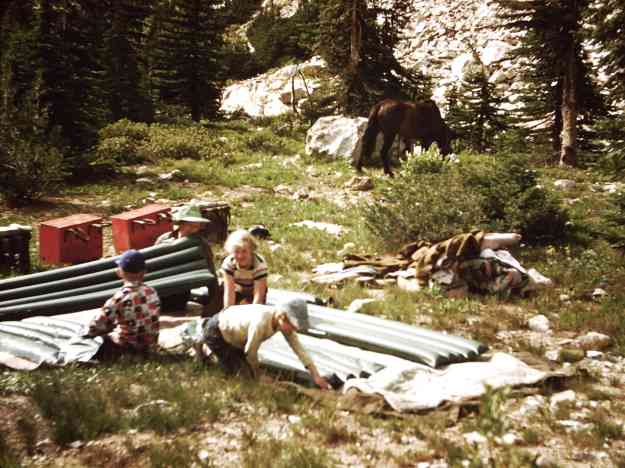
We did have the latest in air mattresses, flimsy plastic tubes molded together that only stayed inflated if no one was on them. Our bedding was heavy woolen blankets carried over the pack boxes on the backs of the horses. The blankets also served as handy padding for us kids when we got tired and were hoisted up on the top of the horses for a ride.

My beautiful picture

1954 — Vicky (sis), Victoria (M0m), Dean, Nyla (sis)

Tents, made of thick canvas, were too heavy to bother with so a couple of canvas tarps sufficed, one under our beds and one lying over them. It kept the dew off as well as the two inches of snow we woke to one August morning.

Every morning Mom and Dad packed our camp into boxes and loaded the horses and every evening it was all unpacked and set into a camp. We kids were kept busy blowing up mattresses and gathering wood, which was lying all about and easily available by breaking off dead branches from trees. Then it was time to play, often by riding the horses bareback.

My beautiful picture

1954 — Dean, Mom, Vicky, Nyla. Boxes fit on pack saddles.

Summer after summer we were crossing different trails in the Sawtooths. It was National Forest land at the time, not a National Wilderness, and in all our treks we only twice ran into Forest Service trail-maintenance pack strings. And only once did we run into another family. It was so unusual we became friends. For years we visited them at their place on Sunnyslope along the Snake River.

So, folks — that was part of my perfectly ordinary childhood. Now, at seventy years old and starting to tell some stories about it, is the first time I’ve realized just how unique it was. Stay tuned for some highlights…

Frost Valley #12: Leaving Bud

When I stumbled into Frost Valley in the spring of 1969, I had been hunting out tiny roads generally heading north and east from where I had spent the winter outside of Princeton, New Jersey. When I left Frost Valley in May I kept my orientation, figuring Maine was as good a goal as any.

I suppose Stan gave me a ride to the end of the valley, where the road crossed the ridge of the Catskills and began its descent to Oliveria and Highway 28. With my heavy sleeping bag and box of paints and a little money saved while working on the estate with Stan, I was doing fine and back where I felt I should be — moving through the landscape. The unknown road to Maine was a shining promise glowing in the unseen horizon.

But my heart was a bungie cord. The further from Frost Valley I got the more I was drawn to Bud and Stan and the cluster of sheds that made up the estate’s main compound. The further I got the harder each step was. I wanted to fall into the glowing promise of the unknown road. But my heart was tied to Bud’s quiet tears.

to Pine Hill JPEG

I turned left when I got to Highway 28, headed north. My head looked forward to adventure but my feet felt no joy. Pride did not want me to go back, admitting some abstract concept of defeat, but my soul was aching. Walking on Highway 28, each step was torn by two desires.

After three miles I was passing the hamlet of Pine Hill. First thing, my eyes scanned a roadside gas & grub and found the outdoor pay phone. I did my best to pass it up.

From the moment I figured I’d call my feet were light and my heart joyful. Stan said, sure, he could keep me busy for the summer and to come on back if I wanted.

These forty-six years later I remember the joy I felt when I turned from the phone and walked across the gas & grub’s parking lot.

As soon as I got to the road, two gals stopped and asked if I wanted a ride. I took the long loop back to Frost Valley.

Frost Valley #11: Loving Bud

I first settled into the Frost Valley estate thanks to a bright-eyed boy.

It was getting late in the day as I walked the valley’s tiny mountain road when a big GMC Suburban passed. It passed half way through the meadow I had just come into when it stopped and a schoolboy jumped out and went running across the meadow into a cluster of buildings. Before I had time to cover fifty yards the boy was in a jalopy, pretty much just a car frame with a motor, and was headed my way. He drove right up and started chatting. His name was Bud. The Suburban was Frost Valley’s school bus. His Dad had been driving it. His Dad was caretaker of the estate where they lived. His Dad could use some help with spring cleaning.

Wintoon lodge

I decided to back track to just before the meadow began, found a wide enough spot to sleep between the road the the “No Trespassing” sign, and settled in for the night. The next morning a International Harvester Scout with a “Constable” sign in the window stopped and Stan, Bud’s Dad, got out. We hit it right off and he suggested I stop in for a hot breakfast (Well, yea!). Sure enough, the local guy who had been helping in the spring was off to school and Stan could use some help with spring clean-up.

Bud and I became good friends that summer. I was an exotic, traveling stranger with stories to tell. He was a spirited kid, probably thirteen or so, and rather isolated in the forest of the Catskill Mountains. We went for walks in the woods and played board games and pool on the family’s pool table and filled our time together with a comfortable enthusiasm for one another.

One day he said he wanted to learn to swim and his mother Lola suggested I teach him in the pond that ran behind the little barn I was sleeping in. It was early summer but mountain water is mountain water — the pond came to my crotch and my legs were freezing. But poor Bud was laid out immersed in the icy existence as I held him on the surface and tried to explain floating and swimming. The entire attempt did not go well and did not last long.

Another Bud & Dean fiasco was my fascination with the brand new invention called a Space Blanket. I was hitch hiking with a heavy woolen World War II Army surplus bed roll and the idea of carrying bedding that weighed an ounce was heaven to contemplate. We were landing on the moon that summer, 1969, so this miraculous material from the space age must live up to its hype, right? Its super-shinny surface reflected body heat so well, there was no need for bulk. The thing had the heft of shrink wrap.

What could go wrong? So, Bud and I set off for an overnight hike up 5,900-foot Slide Mountain with full confidence in my new, light-weight pack.

Well, folks, Space Blankets might make an adequate ground cover, but I assure you they do not keep you warm. Or even isolated from the wind. Unlike being immersed in a cold creek learning to swim with a warm house and dry towel close by, this time Bud and I were in a dark forest in May with a flimsy piece of plastic over us, bundled in our clothes and shivering next to one another to keep warm.

As spring gave way to summer, the chores around the estate settled down and it was time for me to get back on the road. I had gotten close to Stan and Lola and Bud and was sorry to be leaving, and I knew Bud would take it hard. I told him first, the both of us sitting on the ground beside the compound’s workshop. He began to cry and I wanted to. I put my arm around his shoulder and we sat there for a good long while.

That night at the dinner table I told Stan and Lola I thought it was time to move on. Again Bud quietly broke down. It was a very awkward moment for all of us until Stan mentioned the movie Hud and said it was about a relationship similar to Bud and I. That went a long way to ease the discomfort.

I did leave soon after and will be telling the story of my return, my spending the summer, and Bud getting over me enough so when autumn came and it was time to move on for good he was able to say goodby with a twinkling-eyed smile. A smile I carry in my heart to this day.