Author Archives: deansgreatwahoo

Unknown's avatar

About deansgreatwahoo

After graduating in 1964 I headed to Hollywood to be a movie star, only to drop into the '60s. Lucky me! After hitch hiking around the country from '69 to '72, I graduated from Boise State University and settled into waiting tables for a living and pursuing other interests—teaching stained glass at BSU, writing for Boise Weekly and Idaho Magazine, publishing some Idaho and Biblical history, acting in a few local shows, and traveling at the drop of a map. For two years I produced a half-hour public access TV show available at www.greatwahoo.com. In 2011 I was featured in Scott Pasfield's book Gay In America. Through it all I've come up with some stories and am using this blog as an excuse to get them written down.

Buck Brook #13 – Warm in January

I was raised in Boise, Idaho, which has four distinct seasons. So I was raised knowing about the frozen tundras of January. Heck, it sometimes even gets below zero for two or three nights! Sometimes. But usually the middle teens is about as cold as we have to survive.

In the mountain country of upstate New York I learned that what we consider winter in Boise is a far cry from what much of our country considers a normal winter.

In the Catskill Mountains during the January of 1970 we spent several weeks with the daytime temperature never getting warmer than 20 degrees BELOW ZERO!

I know. That’s crazy talk. But it’s true!

And we got used to it. We still took our early morning walks. We still worked outside on the buildings, even getting a foundation under the library. And those of us who smoked still went outside to do it.

We smokers did find a little nook at the front of the men’s dorm that was blocked from the wind on two sides. It faced the south, so if the sun were getting through the clouds at all there was some radiant heat. We’d bundle up and run to the nook and get some good puffs in, maybe even almost finish half a cigarette, before being driven back in to the warmth of the buildings.

By late January it was starting to warm up. One day the sun was all but shining through a light haze and the bare trees of the forest. The light and warming air found us in our t-shirts lighting up in the light of the sun. We weren’t exactly lingering between puffs but each of us did finish our entire cigarette before heading in. It was warm and we talked about it!

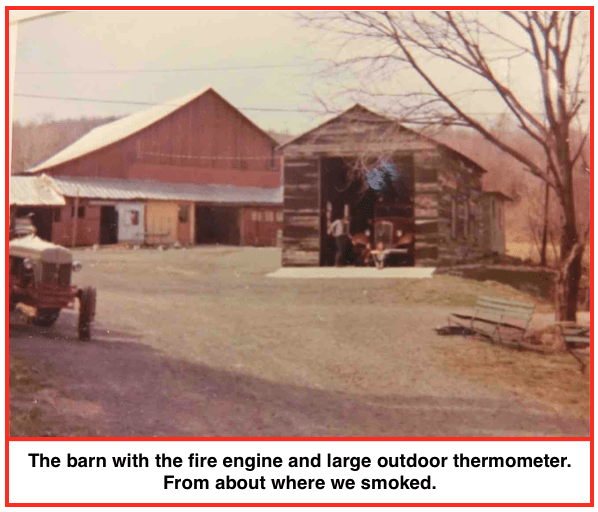
On the way back to the heat of the dorm I gave in to my curiosity and walked over to the barn with the fire engine, where a long metal advertising thermometer hung. I wanted to confirm my suspicion that it was about 32. Freezing! And here we had been out in undershirts smoking an entire cigarette!

Imagine my surprise to find the temperature had not gotten to 32. It was, instead, all the way up to zero.

Barn PNG .png

ZERO!

You spend a month colder that 20 degrees below zero, folks, and you’ll be surprised how much heat there is at zero!

Joining everyone in the dorm I told them I would be telling stories of being warm at zero. I assure you, dear reader, you are not the first to hear about it.

Sawtooth Kidhood 1955: Snowyside Mountain #3

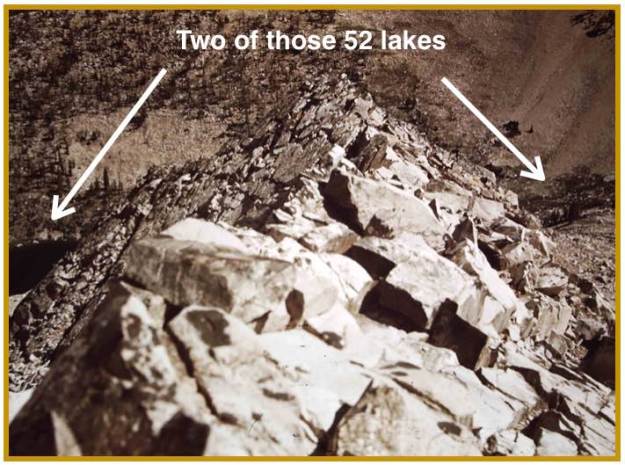
Dad had spent months harping about the the fifty-two lakes that can be counted from Snowyside Mountain. He also had spent months harping about this bit of wisdom from experienced mountain climbers:

People don’t die going up mountains. 

They die coming down. 

This wisdom was a variation of our parents’ instructions that we kids were free to run up all the hills we want, but don’t let them catch us running down!

Whether it be a hill or a mountain, going down is when people are tired. Gravity is making it ease to get going too fast. And if you fall you do not fall a few degrees into the ground and rocks in front of you, you fall well over ninety degrees, through space, picking up speed until you hit the ground and rocks sloping away, where you keep sliding, scraping off skin and perhaps hitting your head on a rock to stop you.

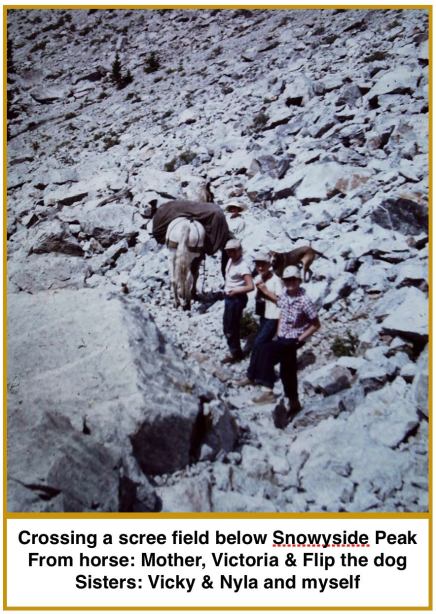
Climbing Snowyside Mountain there were saddles between the smaller peaks before we reached the final summit of the mountain. One of these saddles was very narrow, with loose shale rock sloping steeply away from a path that was only a foot wide. The shale on both sides formed long slopes of scree that would not stop sliding out from under us should we slip onto it.

I remember this narrow path as some six to ten feet long but it might have been four.

INT PNGS.png

Dad paused when he first saw this dangerous path, but his determination to get to the top of Snowyside let him judge Vicky and I as old enough to understand the danger. We three sat down and, legs dangling on both sides of the path for stability, inched our butts along until the danger had passed.

After reaching the summit and counting fifty-two lakes we headed down and again came to this narrow path.

Not one of us hesitated. We walked right across it!

Need I say more about how mountain climbers perish?

Buck Brook #12 – Early Morning Pond

Our Florida retreat wrapped up and students would soon be returning to Buck Brook. By New Years, 1970, we were back in the Catskill Mountains dealing with the cold and snow.

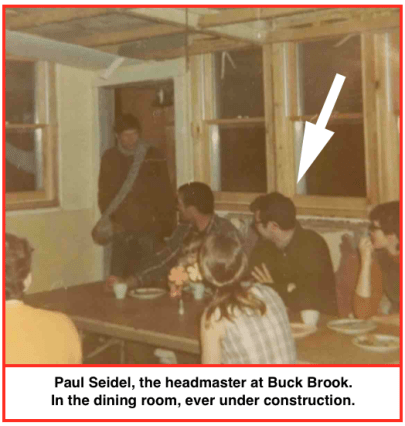
The entire campus began every morning with Paul, the Headmaster, ringing the fire engine bell at 6am. We pulled on whatever pants and parkas we could find, and headed out for a brisk walk.

Yes — every morning. Even when the Catskill temperatures were well below MINUS twenty degrees!

Paul photo INT.png

One of Paul’s favorite walks was up the little creek that ran between the girl’s dorm and the rest of the buildings. I don’t remember it being a terribly long walk but I do remember the winter cold and tramping down the ever increasing snow.

Our destination was a flat spot in the snow surrounded by trees. It was quite serine in a Robert Frost way, even with the noise of some fifteen students and staff shuffling about. As the seasons changed we came to enjoy this flat spot as the small mountain lake it was.

One cold January afternoon some of us actually returned to the pond voluntarily. One of the staff had an ice auger, hooks, and line and was determined to let us in on the fun of ice fishing. I have never had the patience to catch fish in a crowded barrel and I found waiting for a nibble through the ice did nothing to calm my impatience.

Sawtooth Kidhood 1955: Snowyside Mountain #2

Dad boosted my sister and I up the last four-foot vertical rock and we covered the final few feet to the tippy top of Snowyside Mountain. Dad then got right to work counting every one of those fifty-two lakes he had heard about and making sure it was true—you can see through the crystal clear water to the bottom of every single one!

#2A.jpg

My sister Vicky and I set right to work on the most important task of reaching the top of any peak in the Sawtooths — finding one of the boards that were always scattered about, getting out our pocket knives, and leaving our mark at the top of the world.

#2.jpg

Some folks marked their arrival at the top of the world with an initial and perhaps a date or their age. Some made sure their name was complete along with other pertinent information like where they were from. I scratched a bit at my initials before putting that aside and checking out all those lakes. Vicky made sure her carvings were dug deep and would pass the test of weathering at ten thousand feet. But even she had time to check out the lakes before we headed back the same way we had come.

I doubt Vicky’s 1955 effort at permanence is still hanging around at the top of the fifth highest peak in the Sawtooth Mountains, so I’m passing witness here, in our modern means of recording our life’s summits.

~ Here are a few more of Dad’s slides from Snowyside Peak in 1955 ~

#! Borah.jpg

#3 Toxaway Lake?.jpg

#4.jpg

#5.jpg

#6.jpg

Sawtooth Kidhood 1955: Snowyside Mountain #1

My dad had climbed 9,363 foot Greylock Mountain in Atlanta when he was a kid.

Graylocks.png

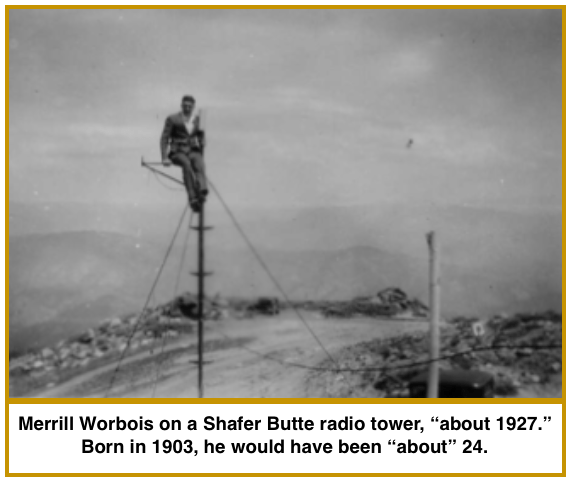
I have a photo of him sitting atop a radio tower on Shafer Butte, a mile above Boise, when he was in his twenties.

radio tower.png

He had something about getting up and looking around.

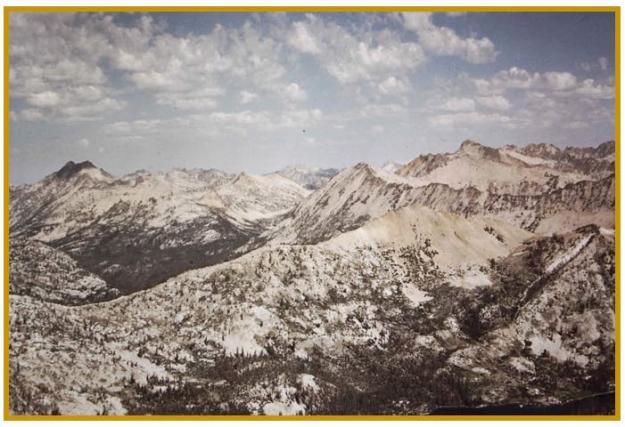
In the 1950s he found out that from Snowyside Peak in the Sawtooth Mountains you can see right through the clear waters to the bottom of fifty-two lakes. Yea, there were some “difficult spots” on the climb to the top. But from what he heard the peak was easily reach by following the ridge that rises from the Alice-Toxaway Loop Trail.

At 10,651 feet, Snowyside is the fifth highest peak in the Sawtooths. In 1955, when I was ten, our family of five broke camp at Toxaway Lake, loaded up the pack horses, and set out for the day’s adventure of checking out those fifty-two lakes.

Snowyside.png

Mom and my little sister made it to where the faint trail up Snowyside’s ridge gave way to rocks, bigger rocks and then boulders. Mom never was comfortable with heights and my sister’s legs were too short to get over the increasingly large stones so they decided to hunker down out of the wind.

My big sister Vicky, dad, Flip the dog and I pushed on.

I remember approaching the top of several peaks only to have another, higher peak appear just ahead. Those jagged high points before Snowyside Peak were a source of great disappointment and consternation.

Ridge.png

Then we came to a vertical wall that stopped us. Dad considered a way around but the slopes were too steep and covered with dangerous scree. Yet looking through fifty-two lakes was calling and soon Dad was pushing from the bottom and Vicky and I managed to scramble past the obstacle. Dad was tall enough and reached the scramble spot on his own.

Unfortunately Flip was a dog who never did follow instructions. And, to be fair, his lack of opposable thumbs for scrambling made his lack of obedience mote, so poor Flip was left behind. We were sure he’d be in the same spot waiting our descent.

The wall turned out to be part of the final assent to the summit of Snowyside Mountain. Soon our eyes were watching the slope in front of us give way to every increasing open sky without another peak taunting “not yet you haven’t reached the top.”

And right there at the top of Snowyside Mountain was a slobbering, smiling, tail-wagging Flip imploring us to come look-see!

Buck Brook #11: Oystering

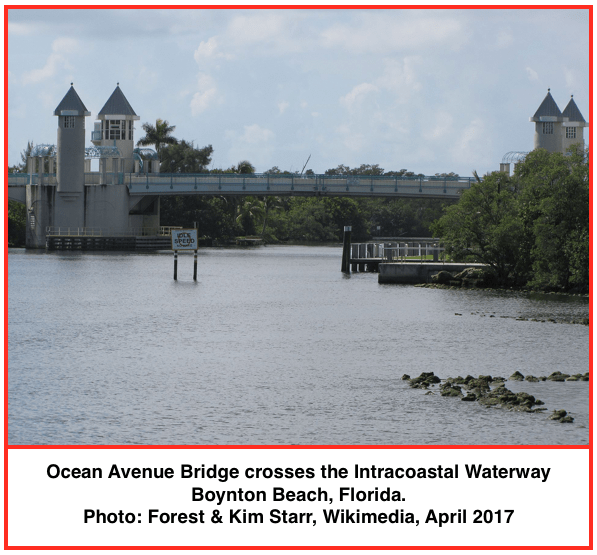
One tradition of the Green Valley School’s annual staff retreat in Florida was an oyster bake. So it was I found myself in a canoe on the waters of the Intracoastal Waterway.

The Intracoastal Waterway is a series of channels protected from open water by islands and sand bars. It runs from Boston, Massachusetts, for 3,000 miles down the Atlantic Seaboard, around Florida, and then along the Gulf of Mexico to Brownsville, Texas. It offers calm waters for boats and ships.

I’ve always found canoes rather tipsy but along the edges of the Intracoastal Waterway I had no trouble reaching over the side of the narrow craft to start oystering. No wonder shippers and pleasure yachts enjoy these calm waters!

photo INT.png

The oystering was easy as picking litter from city streets. Although it was winter solstice, it was also Florida. The water was warm, some two feet deep, and clear as mountain air after a good rain. The oysters were thick as the pile on a carpet.

We had three canoes out collecting for our feast and the staff member guiding the expedition was well versed in oystering these waters. One thing he made a point of was to eat as many of the mollusks as we wanted right as we pulled them from the sea.

So we did. Popped those puppies open and tasted the squirts of water they use as a defense ploy as our knives separated them from their shell and into our gullets. They were delicious, albeit tasting mostly of the sea.

I’ve tried to like oysters that have been preserved on ice and served, dead or dying, on silver trays. But after dragging them straight from the sea I’ve always had trouble enjoying them. The taste of salty water is there but not much else.

On the half shell? Baked? Fried?

Nope. I’ve come to realize I really don’t like oysters and I’m not going to pretend I do. But those fresh and fighting from the ocean waters? I’ll give those another go.

Sawtooth Kidhood 1957: Switchbacks #2

During the summer of 1957 our family found itself at the bottom of a long, steep slope of endless loose shale. It just kept getting more steep the further up it went.

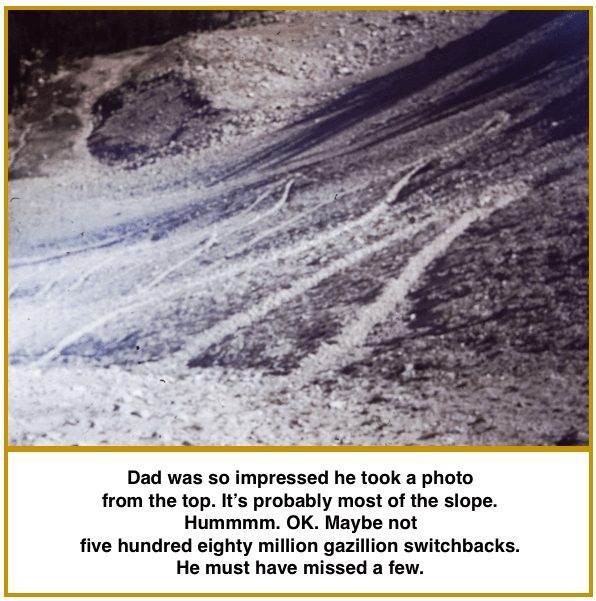
I recognized the zig-zag pattern cut across and up the dangerous scree-covered slope from previous trails called “switchbacks.” But before I had only seen three or five or so zig-zags. These we did not bother to count. Fifty? Eighty? Five-hundred-eighty million gazillion????????

Switchbacks INT.png

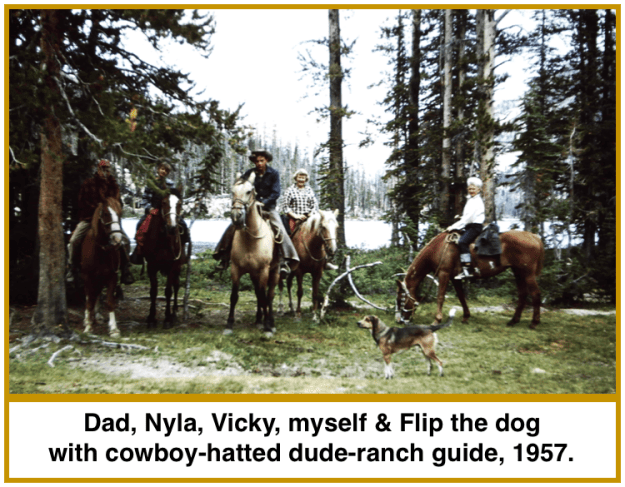
We were mounted on the five horses my parents had rented from a dude ranch in Stanley Basin. I was twelve and my sisters were fourteen and ten.

on horses.png

Mom and Dad explained the principles of shale and scree and gravity to us. They pointed out the horses had been over this dangerous scree many times. They pointed out the trail would get narrower and the horses would have only enough room for their hooves.

They pointed out if we spooked a horse it could step off the trail, slide the scree under its hooves, and we and the horses would be in an avalanche of rocks and horse and our own bodies.

I clearly remember how high up I was on that horse. How tiny the trail looked from up there. And how steep that slope of loose rocks was!

And I remember how the further up the switchbacks I rode the distance to the bottom of the slope grew to an endless potential of the horse and I rolling with tumbling rocks forever.

I don’t know if that dude ranch had to replace the crushed saddle horn I was hanging onto that day. I do remember Mom’s gentle laughter around the campfire that night as she observed, “I’ve never seen three kids sit so straight and so still for so long in my life!”

Sawtooth Kidhood 1957: Switchbacks #1

Most mountain trekking is on gentle slopes made difficult by uneven paths, stones, and fallen trees. But the trails are along ridges or following streams, with the steepness of the paths gaining a few feet in altitude for every ten or hundred of feet forward.

But when the trail reaches the spots between the streams and the ridges, where it is forced to climb to reach a pass between mountain tops, the gain in altitude exceeds the gain in forward movement.

Going straight up these climbs to the pass would have shoes and horses slipping backward and cause erosion where rushing rain and snowmelt follows where feet had trod.

Enter the switchback. The same as skiing back and forth across a slope to keep your speed in check, the switchback runs across the hill at a reasonable grade, then makes a 30 degree turn to run back across the hill. Repeat as many times as needed to reach the mountain’s ridge.

Between mountain peaks there are slopes covered with shale — the rock that has broken off the granite walls thanks to hot and cold and storms and lots of time.

These broken rocks stop sliding down the slope between mountain peaks when they reach their angle of repose, where any object sliding down a slope finds its unique spot where it no longer slides on the steepness of the slope.

The rocks are called shale and all together they are called scree.

screes.png

The rocks have found their place to stop sliding — but only barely. Just like an avalanche, any disturbance will get the scree moving down the slope and the larger the disturbance the more scree will get moving.

A larger disturbance like, say, a boy and a horse slipping off the narrow path of a switchback and tumbling onto the scree-covered slope.

Buck Brook #10: Catamaran

The Saint Johns River runs to Jacksonville, on the very north east corner of Florida. It starts more than half way down the Florida peninsula. It is one of the few rivers that run north in the United States.

map INT.png

On the freeway the distance is 212 miles, yet the river is 310 miles long. The entire drop in elevation of the river is 30 feet — running downhill the height of a three story building in 310 miles! The drop is about one inch per mile, compared to one foot per mile that keeps our irrigation canals moving. The result is a full third of its length is made up of meandering.

river INT.jpg

The flow in the river is so lackadaisical the entire river is basically a long lake. Perfect for a lazy floating along on one of Green Valley School’s catamarans.

The breeze was warm and just enough to cause movement on that very responsive craft. The moonlight was twinkling on the still water.

A slice of Florida paradise, mid-winter, 1969.

corc INT.jpg

Grandjean to Alpine Lake #5: Heartbroken

When we got back to Grandjean after days in the wilderness, a soda pop at the Grandjean Lodge was a real treat.

Then there was the business of unloading the horses and mule. They were glad to be home, free from the weight of being beasts of burden.

Our dog Flip was scurrying about, excited as ever, and happened behind the mule as it was being unpacked. For whatever reason, the mule chose that moment to get spooked and let out a good kick. Flip was so startled he ran back up the trail from whence we had come.

We called and called. And called some more.

We waited and called.

Flip was not coming back.

flip INT.png

Dad had to be at work the next day, so, reluctantly, we packed up the car, waited some more, and drove the hundred slow, winding miles to Boise.

Four days later we got a call from the Lodge saying they had Flip.

They had seen him three times before that. He would get as far as the edge of the lodge property and look around, then head back up the trail.  Each time he was a little slower to run away when the folks at Grandjean started to approach.

Finally Flip was so tired and torn up and famished he let the folks at Grandjean get hold of him. He had been kept in the lodge ever since. He was eating but he was broken hearted.

The folks at Grandjean figured Flip had run back and fourth four times, covering the entire trail we had been camping on for days, in a desperate effort to find us.

So he laid in the lodge at Grandjean, without the energy or will to move. But they were keeping him inside just to make sure he didn’t head up the trail once again.

Two days after the call, Flip was languid on the floor when an ear perked up. In seconds his head was off the floor, aiming for a better listen. And suddenly he was on his feet, barking and whining and dancing and jumping and wild with joy.

It was another ten minutes before the humans could hear the deep throaty V-8 engine of my Dad’s Cadillac driving up the road. But they knew it was coming.

When the green car was well in sight, they let Flip out the door. As he tore past them and out the gate and onto the road his tail was wagging so hard his back legs had trouble continuing to hit the dirt.

Our dad had trouble getting the car door open and then trouble getting out of the car because he was being so jumped on and face-licked by the world’s most joyful soul.