Category Archives: Idaho Events

Arrowrock Dam Spillway

ARROWORCK DAM.jpg

Arrowrock Dam on the Boise River was complete in 1915. For nine years it was the tallest  dam in the world. It was built to hold back water to feed the newly completed New York Canal, the largest of the irrigation projects in the Boise Valley.

As a kid I was fascinated by the massive spillway that passes to the north of the dam. Unfortunately it seems running the spillway is tough on the bull trout that call Arrowrock Reservoir home and use of the spillway was curtailed some time ago.

Until this year. We have a record snowpack and it seems running the spillway has become an option!

I checked it out on Thursday, May 18, 2017 and sure enough the spillway was running! Here’s a little three-minute movie about it.

ARROWROCK SPILLWAY RUNNING

The day after I posted this video of the spillway running I checked the spillway out again. It has warmed up and the snowpack in the upper elevations is melting. The spillway is no longer running. It is gushing —

ARROWROCK SPILLWAY GUSHING

Grandjean to Alpine Lake #4: Strangers Indeed!

Visiting the Sawtooth Wilderness Area today is as awe-inspiring and rigorous as ever. It is also something of a social event with regular exchanges of howdy-dos with strangers on the trails.

When horse packing in the 1950s, any interaction with other people in the Sawtooths was a rare event, indeed.

We once did come across another family out exploring the trails. It was so unusual we became friends and several times drove to Sunnyslope, overlooking the Snake River near Marsing, to visit.

There were only two other times we met another person during the eight treks we took in the Sawtooths. Both times they were men leading long strings of pack mules.

The U. S. Forest Service builds and maintains the trails in the Sawtooth Mountains and it is a constant job. In the spring it takes a surge of saws to open the trails through the winter’s accumulation of downed trees and areas damaged by avalanche and flood. All summer it requires regular clearing of trees blown and blasted down by wind and lightening.

Just how modern trail maintainers travel I don’t know. But the wilderness area is motor free, so I would not be surprised if long lines of mules still carry the tools and supplies needed to keep the wilderness wild while still open to human traffic.

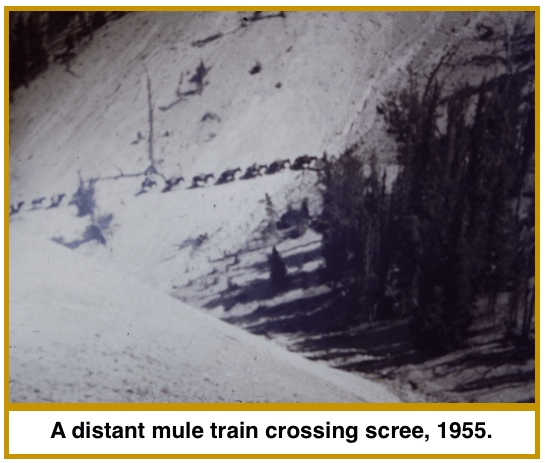
During our horse camping trips in the 1950s, one string of mules was spied in the distance, working its way across a scree of loose stones.

Mule train INT.png

On another trip, a string of mules caught up to us from behind. After a few pleasantries the forest ranger said he had been watching our tracks for most of the day. He had also been watching the prints of very large paws that had been following us for miles. The paw prints of a large lion, known hereabouts as a cougar.

And here I thought I was the only one noticing how pungent sweating horses can get!

Cougar INT.png

Grandjean to Alpine Lake #3: A Cool Dip

Baron Valley.png

For all the majestic beauty of the walk up Payette River and Baron Creek, the highlight of the trek (at least from this story teller’s point of view) was when we reached Little Baron Lake. It was getting late and we were ready to make camp.

Those who know mountain treks know that, yes, it is high altitude and you have to pack to stay warm on very cold nights. But the atmosphere is thin, the sun is direct, and walking uphill sure makes mountains hot during the day.

It had been a long, hot day on the trail by the time we reached Little Baron Lake and the clear waters of the lake were the most inviting vision you can imagine. As soon as Mom and Dad agreed on a camping spot and stopped to make camp, my two sisters went running to the lake, looking for the perfect place to get on a rock with a deep hole beside it.

Within seconds of agreeing on the proper, safe rock, off came their clothes and in they jumped, one right after the other.

And just like that they levitated right back out!

One hint to just how cold a Sawtooth lake can be on a hot August day might have been the glistening white glacier on the other side of the lake. A glacier that came right down into the beautiful, inviting water.

Glaciers in lake.png

Grandjean to Alpine #2: Baron Creek


MAP.png

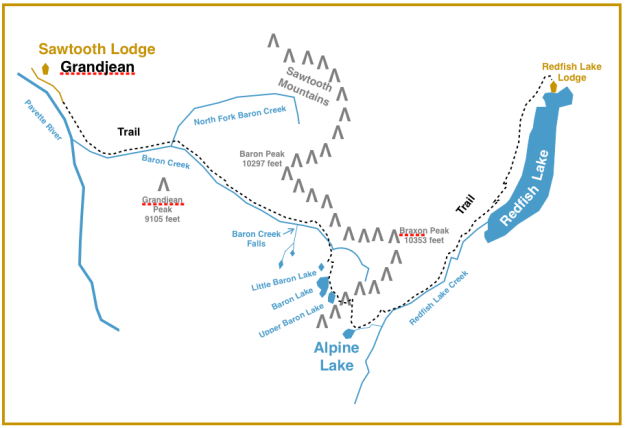
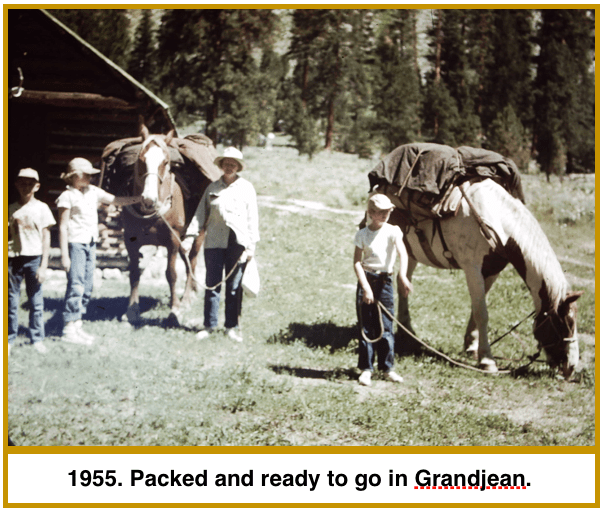
The good folks at Sawtooth Lodge were more than happy to rent us two horses and the gear to pack up our iron skillets, canned food, blankets, Coleman stove, and whatever it takes to keep a family of five clothed and reasonably comfortable for a week. And we kids once again found ourselves watching Mom and Dad balancing pack boxes and cinching the whole kit and caboodle high on the backs of those huge beasts.

1 Grandjean ready.png

2 rock cabin.png

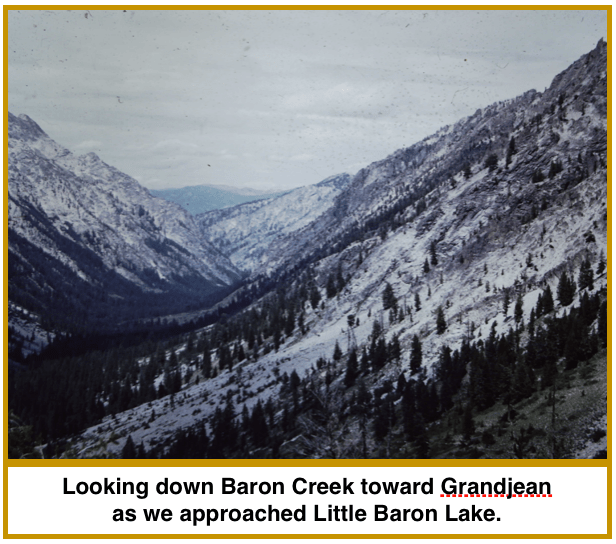
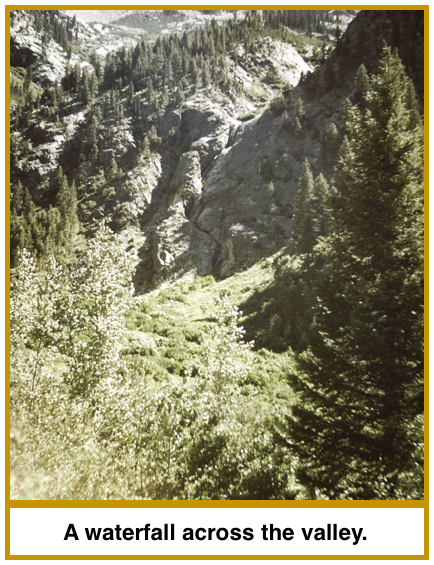
I remember the long, long walk up the south fork of Payette River and Baron Creek. They are narrow valleys with steep slopes rising above tree line to towering granite peaks. Every time we stopped and looked back the valleys seemed more immense, an expanding crevice opening into the distance.

3 Across valley.png

On the steep slopes between the towering stone tops of the mountains and the base of the valleys were all variety of growth. Scrub pine barely hanging on at tree line gave way to aspen and brush with open spaces of grasses and moss. Areas of grey stones lay where they had tumbled from on high. Slicing through the vegetation were avalanche trails. Only low brush grew in the avalanche trails, saved by remaining under snowpack while the power of sliding snow roared above.

Mom spotted a bear with her cubs on our side of the valley, but a goodly distance from us. She and Dad seemed to agree this was a good opportunity to point out “a goodly distance” is just the right place for spotting bears in the wild.

They got no argument from me.

4 treeline.png

Grandjean to Alpine #1: Sawtooth Lodge

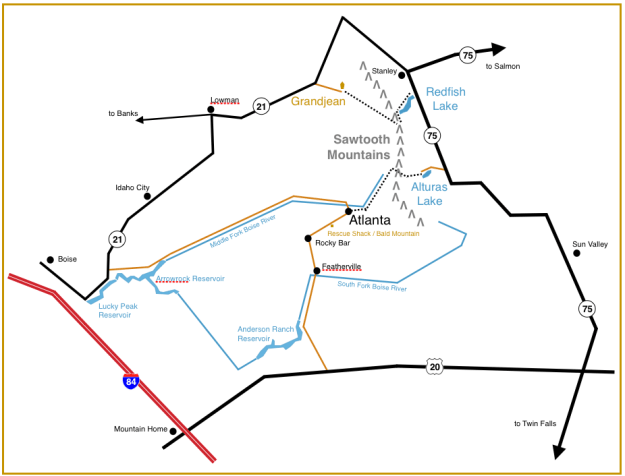
map-all-sawtooths

In 1955, the year after we walked from Atlanta to Alturas Lake, we set off on another primitive camping trip in the Sawtooth Mountains. This time from Grandjean to Redfish Lake.

to-lodge

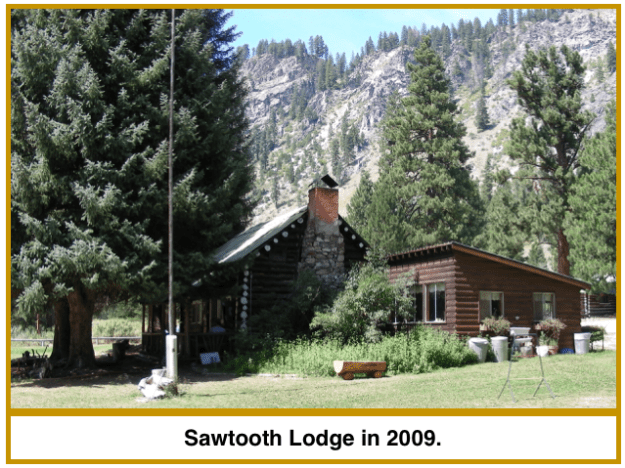
Grandjean is home to Sawtooth Lodge, a tiny log affair established in 1927. A few cabins and a campground round out the site at the end of a dirt road heading up the middle fork of the Payette River.

ledge-09

The lodge has an active stream splashing beside it. As a kid I was fascinated by the iron pipe that ran several dozen yards up the hill beside this stream. We walked up the pipe and watched some of the stream running into the pipe. Before the pipe got to the lodge, it branched in two—one branch headed to the sinks in the lodge and the other into a small, wooden shack of a building.

We looked in the shack and saw the water spewing from a small nozzle and hitting little buckets placed around a spinning wheel. A belt connected the spinning wheel to a generator. I understood the principle of hydroelectricity by this time, but had never witnessed it in such open simplicity.

pelton-wheel-png

Ever since I’ve wanted a house next to a stream that endlessly supplies running water and power.

Now that I think about it, I wonder how much effort the good folks at Sawtooth Lodge put into keeping the water running down that pipe, given freezing winters and constant debris washing down the stream. And I wonder how much jerry-rigging it takes to keep a Pelton wheel, a belt and generator running in the outback of mountain environments.

I think I’ll stick to the grid.

Atlanta to Alturas Lake #10: Shocked

We made it back to Atlanta after a week of dusty horse camping in the Sawtooths. Other than at Alturas Lake we had not seen a soul.

We walked through town to the camp were we had left our car, unpacked the horses, and Dad returned them to the folks who had rented them to us. We spent the night in the Atlanta campground listening to the rushing Boise River. I’m sure Mom and Dad spent the night in sweet dreams, knowing they did not have to pack and unpack horses the next day.

But we did pack the camping trailer, a two-wheeled, fairly light-weight trailer with high sides that fit around the large canvas tent, cotton mattresses, blankets, pots, pans, Coleman stove, supplies of gas and boxes of food that it took for us to be outdoorsmen.

I was expecting a seventy mile trip down the Boise River to home but instead, just outside of Atlanta, we turned left and began a long climb up James Creek and over Bald Mountain. We explored the little survival cabin where Peg Leg Annie had her frozen legs cut off. We explored Rocky Bar and I watched the crusted food in the corners of Charlie Sprintle’s mouth while he chatted with Dad. We checked out Featherville as we drove by, and the wide backwaters of Anderson Ranch Reservoir. Then we finally hit paved road and the miles flew by smoothly and dust free!

shack-int

sprintles-int

It didn’t seem long before we slowed down and Dad turned left onto another dirt road. The sign said, “Alturas Lake.”

And sure enough, some ten minutes later we passed the lodge where Dad had rented the steel boat that could not sink. And we were unpacking at the very camp site where a few days before we had packed up horses.

I was shocked! Sure, I had seen the cars and trucks at Alturas Lake. But, really? We could have just driven from Boise in three hours????!!!!!

Well. What kids haven’t wondered about the sanity of their parents?

map-int

Atlanta to Alturas Lake #9: Dumped!

The return trek from Alturas Lake to Atlanta was going along just dandy when Dad learned a lesson about kindness to animals.

When picking up the pack horses from Atlanta locals, I watched as the man we were renting them from showed my dad the secret to cinching a pack saddle on a horse.

A pack saddle is held in place with a belt that loops under the horse’s rib cage. With the saddle in place the man ran this belt under the horse and through rings on the saddle to cinch it tight. Several times, he did what he could to get the saddle tightened down when the horse let out it’s breath. Then, when things were good and tight and there was no more cinching to do, he pulled hard on the belt and delivered a serious kick right in the horse’s ribs. The horse snorted and the belt slipped two or three inches through the rings and got tied off.

“They’ll always keep some room and if you don’t get it tight they can drop their load any time they choose,” was the man’s advice. Even so, I felt sorry for the horse.

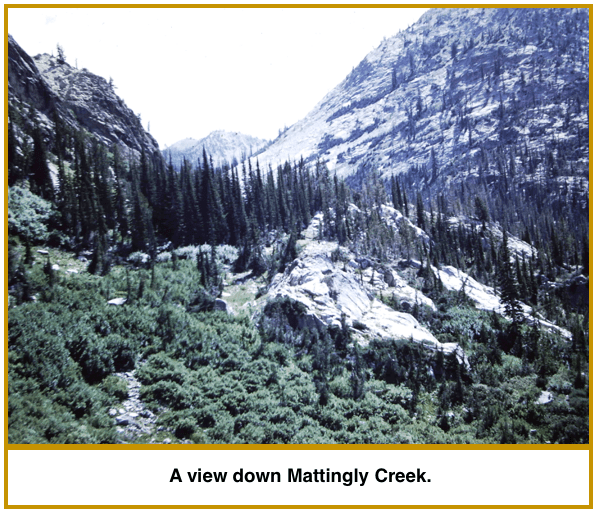
The return from Alturas Lake followed the same steady climb we had come down from the summit, across the meadow of blue flowers, and on down the valleys of Mattingly Creek and then Middle Fork of the Boise River.

mattingly-creek


middle-fork

Even we kids knew going down is the dangerous part of climbing. That’s when heads hit rocks hard during a fall. And we remembered going up a very steep and very rocky section of the trail some five miles out of Atlanta. We kids got off the horses to pick our way down that several hundred feet.

It was right in the center of that steep and difficult part of the trail — right where it was the steepest and dustiest and most awkward — the pack on one of the horses simply slid to one side and landed in the powdery dust.

dropped-pack

The horse didn’t look one bit sorry about it, either. Indeed, he seemed quite pleased with himself!

I was too young to help unpacking the bedding and canvases and heavy pack boxes there on that steep slope. Nor do I remember if Mom and Dad carried all the goods to a more level place to pack them back on the horse, but it sure seems they could not have saddled and packed that animal in as steep a place as the horse was standing.

What I do know is that horse got a damn solid kick with Dad’s boot when the saddle was being cinched up. And the horse looked completely convinced it had been worth it.

Atlanta to Alturas Lake #8: New Boots

In all the planning Dad put into our first trek across the Sawtooth Mountains, one thing he made sure to do was think of footwear. We kids were outfitted with the popular Converse “tennis shoes” of the time, a modern cobbler’s approach to canvas uppers on rubber souls. Being heavier, Dad got himself a good pair of stout leather hiking boots.

Brand new stout leather hiking boots.

Half way through the first day of the walk from Atlanta to Alturas Lake there were blisters coming up on Dad’s heals. Some extra padding helped but the blisters were not to be abated.

By Alturas Lake Dad had blisters inside of the first blisters, including some on toes. I remember them being popped to make room for his foot to get back in the boots.

Well, folks, there are no cobblers or shoe stores at Alturas Lake, so the walk back to Atlanta was faced with the knowledge more skin would be rubbed raw in the future. And it was.

1954 new boots

Meanwhile we kids were prancing about in our thin canvas shoes with nary so much as a red splotch to show for it.

I’m not sure if those boots found the nearest trash can when we got back to Atlanta or not, but my dad was not one to toss out anything that had any life left in it. There is a photo from hiking in the Sawtooths the next year that has him wading barefoot in a creek while holding a pair of boots that look similar.

1955 Old boots

One thing I do know — he never again wore new footwear of any kind when taking off on a mountain trail. And I’m pretty sure he considered an extra pair of very comfortable shoes worth packing along just in case.

Golden Moment

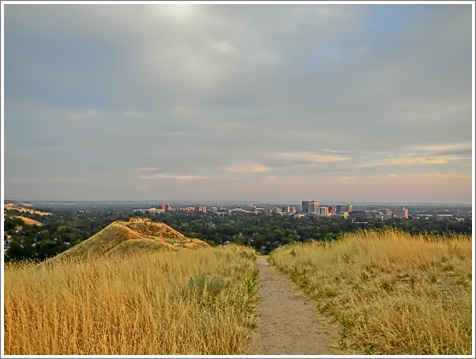
On Sunday, August 14, 2016, I took a little stroll up Camelback Hill just up the street from my home. On this path I usually stop at a favorite spot for a little thanking the Gods for their beautiful existence. Just as I got to my thanking spot the sun emerged from the overcast.

sun

The light caught the dried grasses of our southern Idaho hills and turned them golden.

north

northeast

And did a fine job of lighting up Boise.

city

Fortunately I took some photos before pausing for my thank-yous. By the time the Gods were properly greeted the sun was again behind the cloud and the golden was gone.

gone

Alturas Lake #7: Choppy Water

The white caps are the strongest memory of my encounter with Alturas Lake.

Alturas Lake is two miles long and stretches along the valley of Alturas Lake Creek. There is a relentless flow of cool air settling from the Sawtooth’s high peeks down to the floor of Stanley Basin, the site of Alturas Lake. With two miles for the wind to blow along the surface of the lake, the water was always riled up. Choppy swells covered the lake like meringue on a lemon pie and I was introduced to the term, “white caps.”

What better place to rent a tiny boat and take the family on a putt-about?

life vests

It was all perfectly safe, we were assured by the man behind the counter of the Alturas Lake Lodge. The boats were all steel, which would sink like the Titanic. But at both the front and back of the boats were compartments sealed shut with strong welds. The trapped air in the compartments would float the boat should the choppy waters cause it to capsize.

front end

At the time I did not know of the Titanic and its unsinkable compartments. Nor do I remember the man behind the counter making the comparison.

It was a lovely time on the choppy lake, being beaten on the butt by the metal seats and sprayed in the face with the wind-blown icy water of glacial melt. We frolicked on the beach at the far end of the lake for an afternoon and then headed on the two-mile journey to the lodge.

beach

Checking out my Dad’s slides, I did seem to have an encounter with the lake on the return trip. We were not at a pier or sandy beach, so perhaps my sisters, mother and I were being let off near the campground while Dad returned the boat. I vaguely remember a mass of leaves, logs and twigs luring me off the boat. With no experience on lake water, it looked perfectly solid but was, instead, floating in some two feet of water.

My dad caught my nine-year-old reaction to being shocked at the unexpected results.

crying